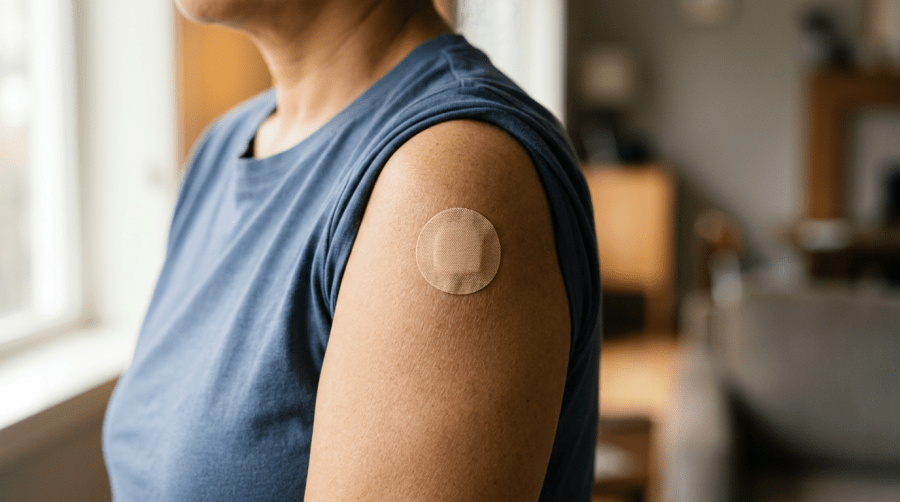
Round beige adhesive bandage on an adult's upper arm after a vaccination

2026-2027 COVID Vaccine: Who Qualifies, and Do You Need a Doctor’s Note?

The updated COVID-19 shots were approved on August 27 and 28, 2026, and they started shipping the same week. If you went looking for one last fall and got turned around at the pharmacy counter, or told to come back with something in writing from your physician, this post is mostly for you.

Here is what is out, who can get it, what counts as high risk, and what the virus is doing right now.

What was approved, and when you can actually get it

FDA cleared XFG-adapted formulas from all three manufacturers. Pfizer-BioNTech’s Comirnaty was approved August 27 (1). Moderna’s Spikevax and mNexspike followed (2). Novavax announced its Nuvaxovid approval on August 28, alongside clearances in the EU and Japan (3). XFG is a recombinant in the JN.1 family, and it replaces last season’s LP.8.1 formula (4).

Now the part I get asked about most, and the part I cannot give you: there is no state-by-state rollout calendar. No health department publishes a date on which residents of that state become eligible, because distribution is commercial rather than federally allocated. Manufacturers ship to distributors, distributors ship to chains and clinics, and stock arrives store by store over days to a few weeks. Your pharmacy may have doses Tuesday while the one four miles down the road is waiting on Thursday’s truck.

So do not wait for an announcement. Set an alert on your pharmacy’s scheduling page, or call and ask when their first shipment lands.

Where the virus is right now

I want to be careful here, because the headlines and the data are telling slightly different stories.

CDC’s wastewater program is the most reliable read we have. For the week ending August 22, 2026, the national wastewater viral activity level for SARS-CoV-2 was 2.14, which CDC classifies as Very Low (5). That same number sat at 1.00 through most of July. It has roughly doubled in six weeks while staying inside the lowest category. So yes, transmission is climbing on the usual back-to-school schedule. No, we are not in a surge yet.

The regional picture is lopsided. The South is currently the highest region at 3.34. Texas is the real outlier at 11.76 across 40 reporting sites, the only state sitting in the Very High band. Mississippi reads 8.92 and South Carolina 7.47, but both are flagged for limited coverage, with two and three reporting sites respectively, so treat those as a signal rather than a measurement. Hawaii is at 7.26 across ten sites. Then Nevada 6.01, California 5.87 across 79 sites, West Virginia 5.61, Louisiana 5.31, and Florida 5.30 (6).

The variant names have shuffled again. Over the four weeks ending August 1, 2026, the two most common in CDC’s sequencing were SW.2 at about 21 percent and XFG.1.1 at about 16 percent (7). XFG.1.1 belongs to a family. Count its close relatives together and the XFG group accounts for roughly 35 percent of what is going around, which is why FDA picked XFG as this year’s vaccine target. NB.1.8.1, the one the press nicknamed Nimbus last summer, has faded to about 4 percent. BA.3.2 sits near 2 percent.

Here is the caveat, and most coverage skips it. Those percentages rest on a very small number of samples. CDC flags all eighteen of the lineages it reported for that period as based on fewer than ten sequenced specimens, or unreliable for other statistical reasons (7). In February the agency could name more than two hundred lineages circulating in the country. This month it could name eighteen. Genetic sequencing of the virus has dropped off sharply, so the variant list is a rough sketch rather than a headcount.

Which is why I put more weight on the wastewater curve than on the variant percentages right now. Genomics tells you the flavor. Wastewater tells you the size.

The page to bookmark

CDC posts wastewater viral activity by state here, and it is updated every Friday with the previous week’s numbers:

https://www.cdc.gov/wastewater/respiratory-viruses/state.html

It covers influenza A, SARS-CoV-2 b (Covid-19), and RSV on the same page, so you can see which of the three is actually moving in your area before you decide whether that sore throat needs a test. If you want the county-level view alongside emergency department visit data, CDC’s Respiratory Illnesses Data Channel has a search box for your state or county:

https://www.cdc.gov/respiratory-viruses/data/index.html

Bookmark the first one. It answers the question patients are really asking, which is not “how bad is COVID nationally” but “is there anything going around here.”

Who the FDA says can get it

The licensed indications are narrower than they were before 2025, and they differ slightly by product:

  • Comirnaty (Pfizer-BioNTech), mRNA: ages 65 and older, or ages 5 through 64 with at least one condition that raises the risk of severe COVID-19 (1)
  • Spikevax (Moderna), mRNA: ages 65 and older, or 6 months through 64 with at least one such condition (2)
  • mNexspike (Moderna), mRNA: ages 65 and older, or 12 through 64 with at least one such condition (2)
  • Nuvaxovid (Novavax), protein-based rather than mRNA: ages 65 and older, or 12 through 64 with at least one such condition (3)

CDC’s own recommendation, unchanged since the September 2025 ACIP vote, covers everyone 6 months and older under individual-based decision-making (8). So the federal recommendation is broader than the federal license. That gap is exactly where the confusion at the pharmacy counter lives, and nobody at either agency has resolved it for you.

The high-risk list is longer than you think

Most people badly underestimate how wide this list is. CDC’s conditions, in alphabetical order rather than order of risk: cancer, cerebrovascular disease, chronic kidney disease at any stage, chronic liver disease, chronic lung disease including asthma, cystic fibrosis, dementia and other neurologic conditions, type 1 or type 2 diabetes, disabilities, heart conditions, hemoglobin blood disorders, HIV, an immunocompromising condition, mental health conditions, overweight and obesity, physical inactivity, pregnancy, current or former smoking, solid organ or stem cell transplant, substance use disorders, and tuberculosis (9).

Read the back half of that again. Overweight is defined as a BMI of 25 or higher (9). About 72 percent of American adults age 20 and over fall at or above that line, combining the 31.7 percent who are overweight with the 40.3 percent who have obesity (10). Current smoking counts, and so does former smoking. So does physical inactivity. So does depression.

Here is my opinion, and I hold it firmly. A criteria list that broad is not functioning as a clinical gate. It is functioning as paperwork. If you are an adult in the United States, the odds are strong that you already qualify under a criterion you would not have thought to claim, and the honest thing for the system to do would be to say so out loud instead of making each person audit themselves at a kiosk.

Do you need a note from your doctor?

Short answer: almost certainly not, and you should not assume you do.

On September 19, 2025, ACIP voted to recommend COVID-19 vaccination for everyone 6 months and older through individual-based decision-making. In the same meeting it took up a proposal that would have let jurisdictions require a prescription, and that proposal failed on a tiebreaker cast by the committee chair (8, 11). CDC’s position is that the required conversation can happen with a pharmacist, a nurse practitioner, or a PA standing right there at the counter. No written order from your physician.

What tripped people up last fall was state law rather than federal policy. Several states had written pharmacist vaccination authority so that it tracked ACIP’s recommendation language directly, and when that language narrowed, pharmacists in those states abruptly lost standing authority to vaccinate without a prescription. By late September 2025, 26 states had issued standing orders or executive actions restoring broader access (12). The rest had not, and store-level policy varied inside states that had.

Two phone calls save you an afternoon. Call the pharmacy, ask whether they need a prescription for someone your age and situation, and ask whether the 2026-2027 formula is physically on their shelf yet. Then call the number on the back of your insurance card and ask what your plan covers this season. Your state health department’s immunization page is worth two minutes as well, since that is where a new standing order would appear first.

And if a pharmacy does turn you away for want of an order, that is a five-minute problem for your physician to solve, not a reason to abandon the shot. Call the office. Do not walk out and let it go until spring.

Why I think the restrictions backfire

Because the numbers are already bad, and friction is the best explanation for them.

Only 17.5 percent of American adults received the 2025-2026 COVID vaccine, measured at the close of the season in February 2026 across a survey sample of roughly 197,000 people (13). Among adults 65 and older, the group with the clearest, least-debatable benefit, coverage reached 33.5 percent (13). Two-thirds of the highest-risk group in the country did not get vaccinated.

I do not believe most of that gap is ideological. Some of it is. Most of it is drag. Every additional step you insert between a mildly willing person and a needle removes some of them, and the removal is silent. An eligibility attestation form removes a few. A phone call to confirm the pharmacy will actually do it removes a few more. An uncertain bill removes more still. None of those people write a letter explaining why they gave up. They just do not come.

There is a second cost that gets less attention. When the government tells healthy adults they no longer qualify, the message the public hears is that the shot is not worth much. That message does not stay inside its intended audience. It reaches the 68-year-old with COPD who did qualify, who now assumes the whole thing has been downgraded, and who skips it.

If you decided back in 2021 or 2022 that two doses were enough and you have not thought about it since, I would ask you to reconsider on narrow, unromantic grounds. Not because the pandemic is back. Because protection fades, this year’s formula is matched to what is circulating now, and the downside of a sore arm for two days is very small next to a week of illness you did not need to have.

Has the virus changed?

Not in the way people fear. Severity has not meaningfully increased. WHO and ECDC have continued to rate the currently circulating variants as low risk for severe outcomes, and the mutations driving the current lineages are the immune-evasion kind rather than the tissue-damage kind. Laboratory work on XFG published in 2025 found roughly a two-fold drop in neutralizing antibody effectiveness compared with the then-dominant lineage, which explains reinfection without implying worse disease (14).

Symptoms are the familiar Omicron picture. Sore throat, often genuinely severe. Hoarseness. Congestion, cough, fatigue, headache, body aches, and sometimes nausea or loose stools. Loss of smell is far less common than it was in 2020. The “razor blade throat” description that attached itself to NB.1.8.1 in 2025 has stuck around in press coverage, and it is a real complaint, though it is also just a bad Omicron sore throat rather than a diagnostic sign.

What to monitor: shortness of breath at rest or on minimal exertion, chest pain, confusion or unusual difficulty staying awake, bluish lips, and an inability to keep fluids down. Watch for the pattern where someone improves for several days and then clearly worsens around day seven to ten. If you own a fingertip pulse oximeter, a resting reading that keeps coming back at 94 percent or below deserves a same-day call, not a wait-and-see.

Treatment still exists and is still underused. Nirmatrelvir-ritonavir has to be started within five days of symptom onset in adults at high risk of progression, which as we established covers a very large share of adults (15). Day six is too late. If you are in a risk category, know before you are sick how you would reach a clinician quickly.

How long do you stay home?

CDC no longer has a five-day isolation rule, and has not since 2024. The current guidance is symptom-based. Stay home and away from others while you are sick. You can return to normal activities once both of the following have been true for at least 24 hours: your symptoms are improving overall, and you have had no fever without using fever-reducing medication (16).

Then take added precautions for the next five days. Mask well, keep some distance, improve ventilation, and test before you spend time around anyone vulnerable. If a fever returns or you get worse after going back out, go home again and restart the same clock (16).

On work: CDC does not recommend a fixed number of days off, and there is no federal number for your employer to enforce. Your workplace policy is its own creature, and so is your child’s school district. If HR asks for a return-to-work note, that is a workplace requirement rather than a public health one, and it is worth saying so plainly when you ask your physician for it. Healthcare workers and staff in long-term care facilities are the exception and should follow their facility’s occupational health rules instead.

What else lowers your risk

The vaccine is the biggest lever. Metabolic health is the second one, and it is the one you have some control over between now and January.

CDC’s own analysis of 148,494 adults treated at 238 US hospitals found risk of COVID-19 hospitalization was lowest at a BMI of 24.2, ICU admission lowest at 25.9, and death lowest at 23.7, with risk climbing sharply above those points (17). That is a dose-response curve, not a threshold effect, which means movement in the right direction counts even if you do not reach a target number.

Two other findings are worth putting side by side, because together they say something more useful than either does alone.

In a Scottish study of 3.6 million people, vaccinated adults with a BMI over 40 were 76 percent more likely to be hospitalized or die from COVID-19 than vaccinated adults at a normal BMI (adjusted rate ratio 1.76, 95% CI 1.60 to 1.94). In the prospective arm of the same work, 55 percent of people with severe obesity had unquantifiable neutralizing antibody titers six months after their second dose, compared with 12 percent of people at a normal BMI. A third dose restored neutralizing capacity, and then it declined faster again (18).

Meanwhile, in a cohort of 9.17 million adults in England, protection against hospitalization two weeks after the second dose was essentially identical across BMI categories, with an odds ratio of 0.32 in people with obesity against 0.34 in people at a healthy weight. Protection against death was actually stronger in the obesity group, 0.26 against 0.39 (19).

Put those together and the conclusion is not the one people expect. The vaccine works in people with obesity. Its protection simply fades faster. That is an argument for getting the seasonal dose rather than skipping it, and it is the single clearest reason I push seasonal vaccination hardest in my obesity medicine patients.

If you are working on weight for metabolic reasons, this belongs on the list of reasons alongside the ones you already know. I have written about the current medication options in New Weight Loss Pills Foundayo and Wegovy Explained, and about what sustains loss over years in Doctor Supervised Weight Loss: What Works Long Term. For the version of this discussion from last season, including how the eligibility fight started, see 2025 COVID-19 Vaccine: Eligibility, Prescriptions, and Debate.

Two smaller things. You can get the COVID vaccine and the flu vaccine at the same visit, one in each arm, and doing so is the single easiest way to make sure both actually happen (20). And CDC’s risk list includes physical inactivity as its own line item, which is a quiet reminder that the walk you keep meaning to start is doing more than one job.

For patients

Check the wastewater page for your state before you decide how careful to be this month. Call your pharmacy, ask about stock and about whether they need a prescription where you live, and book the appointment while you are on the phone. If you are 65 or older, or you have any condition on that list, do not let a form at the counter end the attempt. If you have been waiting since your first two doses in 2021, this is a reasonable year to restart.

For colleagues

Three practical notes. First, expect the FDA-license-versus-CDC-recommendation gap to generate pharmacy callbacks again this fall, and consider building a standing message your staff can send rather than routing each one to you. Second, screen for eligibility criteria your patients will not volunteer: former smoking status, physical inactivity, and a documented mental health condition all qualify under the CDC list and are all commonly missing from problem lists. Third, if you practice by video as I do, the eligibility conversation is straightforward to complete in a visit that is already happening for something else, and it takes about ninety seconds.

The Bottom Line

The 2026-2027 vaccines are approved, matched to XFG, and shipping now. There is no statewide rollout date to wait for, so call your pharmacy. You very likely qualify under criteria broader than you assume, and you almost certainly do not need a note from me or anyone else, though it is worth one phone call to confirm before you drive over. COVID activity is low nationally and rising, with Texas and the South well ahead of everyone else. And if you stopped after your first two doses because the emergency ended, the case for one more is quiet and practical rather than dramatic: your protection has faded, this formula matches what is going around, and the shot is easier to get than the illness is to sit through.

Scott Rennie, D.O.
Board Certified in Obesity Medicine and Family Medicine

This blog is for educational purposes only and does not constitute individual medical advice. Always consult your own physician before making changes to your health, medications, or treatment plan.

Sources

  1. Pfizer and BioNTech Receive U.S. FDA Approval for XFG-adapted COVID-19 Vaccine. August 27, 2026. https://www.pfizer.com/news/press-release/press-release-detail/pfizer-and-biontech-receive-us-fda-approval-xfg-adapted
  2. Moderna Receives U.S. FDA Approval for Updated 2026-2027 COVID-19 Vaccines. August 2026. https://www.biospace.com/press-releases/moderna-receives-u-s-fda-approval-for-updated-2026-2027-covid-19-vaccines
  3. Novavax’s Partnership Strategy Continues to Deliver with XFG-adapted Nuvaxovid Approvals in the U.S., EU and Japan for the 2026-2027 Vaccination Season. August 28, 2026. https://www.biospace.com/press-releases/novavaxs-partnership-strategy-continues-to-deliver-with-xfg-adapted-nuvaxovid-approvals-in-the-u-s-eu-and-japan-for-2026-2027-vaccination-season
  4. U.S. Food and Drug Administration. COVID-19 Vaccines (2026-2027 Formula) for Use in the United States Beginning in Fall 2026. https://www.fda.gov/vaccines-blood-biologics/industry-biologics/covid-19-vaccines-2026-2027-formula-use-united-states-beginning-fall-2026
  5. CDC. National Wastewater Data for Respiratory Viruses. Data for the week ending August 22, 2026; updated August 27, 2026. https://www.cdc.gov/wastewater/respiratory-viruses/national.html
  6. CDC. State and Territory Wastewater Data for Respiratory Viruses. Data for the week ending August 22, 2026. https://www.cdc.gov/wastewater/respiratory-viruses/state.html
  7. CDC. SARS-CoV-2 Variant Proportions. National estimates, four-week period ending August 1, 2026; published August 28, 2026. https://data.cdc.gov/Laboratory-Surveillance/SARS-CoV-2-Variant-Proportions/jr58-6ysp
  8. U.S. Department of Health and Human Services. ACIP Recommends COVID-19 Immunization Based on Individual Decision-making. September 19, 2025. https://www.hhs.gov/press-room/acip-recommends-covid19-vaccination-individual-decision-making.html
  9. CDC. People with Certain Medical Conditions and COVID-19 Risk Factors. https://www.cdc.gov/covid/risk-factors/index.html
  10. National Center for Health Statistics. Prevalence of Overweight, Obesity, and Severe Obesity Among Adults Age 20 and Older: United States, 1960-1962 Through August 2021-August 2023. https://www.ncbi.nlm.nih.gov/books/NBK621182/
  11. CDC advisers vote that patients must consult a health care provider for Covid-19 vaccination, but no prescription required. CNN, September 19, 2025. https://www.cnn.com/2025/09/19/health/cdc-acip-hepatitis-mmrv-covid-vaccine
  12. Kates J, Bell C, Michaud J, Williams E, Tolbert J. Tracking State Actions on Vaccine Policy and Access. KFF, September 24, 2025. https://www.kff.org/state-health-policy-data/tracking-state-actions-on-vaccine-policy-and-access/
  13. CDC. COVID-19 Vaccination Coverage, Overall and by Selected Demographics and Jurisdiction, Among Adults 18 Years and Older, by Season. National Immunization Survey-Fall Respiratory Virus Module, week ending February 21, 2026. https://data.cdc.gov/d/ksfb-ug5d
  14. Gavi. Eight things you need to know about the new “Nimbus” and “Stratus” COVID-19 variants. June 16, 2025. https://www.gavi.org/vaccineswork/eight-things-you-need-know-about-new-nimbus-and-stratus-covid-variants
  15. U.S. Food and Drug Administration. PAXLOVID Patient Eligibility Screening Checklist Tool for Prescribers. https://www.fda.gov/media/158165/download
  16. CDC. Preventing Spread of Respiratory Viruses When You’re Sick. https://www.cdc.gov/respiratory-viruses/prevention/precautions-when-sick.html
  17. Kompaniyets L, Goodman AB, Belay B, et al. Body Mass Index and Risk for COVID-19-Related Hospitalization, Intensive Care Unit Admission, Invasive Mechanical Ventilation, and Death, United States, March-December 2020. MMWR Morb Mortal Wkly Rep. 2021;70(10):355-361. PMID 33705371. https://pubmed.ncbi.nlm.nih.gov/33705371/
  18. van der Klaauw AA, Horner EC, Pereyra-Gerber P, et al. Accelerated waning of the humoral response to COVID-19 vaccines in obesity. Nat Med. 2023;29(5):1146-1154. PMID 37169862. https://www.nature.com/articles/s41591-023-02343-2
  19. Piernas C, Patone M, Astbury NM, et al. Associations of BMI with COVID-19 vaccine uptake, vaccine effectiveness, and risk of severe COVID-19 outcomes after vaccination in England: a population-based cohort study. Lancet Diabetes Endocrinol. 2022;10(8):571-580. PMID 35780805. https://doi.org/10.1016/S2213-8587(22)00158-9
  20. CDC. Staying Up to Date with COVID-19 Vaccines. https://www.cdc.gov/covid/vaccines/stay-up-to-date.html

Plain grey canvas walking shoes, a smooth stone and an unlabeled clear glass bottle on a wooden floor in daylight.

Longevity Medicine: What Actually Works, and What Doesn’t

Longevity medicine is a wide field, and most of it is not what gets marketed. This is a review of what the evidence actually supports, from fitness and blood pressure to the drugs and supplements patients ask about by name.

Patients bring me longevity questions on video, which is how every visit I do happens. It usually arrives as a general question about what I recommend for living longer, followed by one specific thing they read about online. Phosphatidylcholine. Rapamycin. GLP-1 medications.

Here is the part that disappoints almost everybody. The things with the largest measured effect on how long you live are cheap, boring, and nobody can patent them, so nobody sells them. The drugs people ask about by name sit lower on the list, and several sit there with no human results at all. That does not make them worthless. I prescribe GLP-1 receptor agonists and think they are the most important thing to happen to metabolic medicine in my working life. The point is ordering.

What actually works, and it is not a close call

Start with cardiorespiratory fitness, which means how well your heart and lungs move oxygen while you work hard. Nothing else here comes close to it.

Mandsager’s team at Cleveland Clinic followed 122,007 patients who had treadmill tests between 1991 and 2014. The fittest group came out at an adjusted hazard ratio of 0.20 against the least fit (1). A hazard ratio compares the risk in one group against another. Anything under 1.00 means less risk, so 0.20 means the fittest people died at roughly a fifth the rate of the least fit. That is an enormous gap.

That paper also produced the line that being unfit is worse than smoking, and here is the correction. It reported hazard ratios of 1.41 for smoking and 1.40 for diabetes sitting next to 1.41 for below-average fitness (1). Those are similar sizes inside one model. Nobody raced them against each other, and a poor treadmill result is partly a measure of disease nobody has found yet. The pattern does hold up elsewhere, at roughly 14 percent lower death rates for each one-MET gain in fitness (2). A MET is a unit of effort, and one MET is about what your body burns sitting still, so gaining one is real training.

Resistance training is the second lever, and the useful finding is where it stops. Momma pooled dozens of studies and found that any muscle-strengthening work was linked to a 10 to 17 percent lower risk of death, heart disease, cancer and diabetes. The benefit peaks at 30 to 60 minutes a week and flattens after 60 (3). Two half-hour sessions. That is the whole prescription, and the flattening is the part fitness content never mentions, because there is no business in telling somebody they are done.

Grip strength comes at it sideways. In PURE, across 139,691 adults in 17 countries, the death rate rose with a hazard ratio of 1.16 for every 5-kg drop in grip (4). Grip stands in for how much muscle you carry. Nobody should go train their hands.

Nobody ever counted to ten thousand

Paluch pooled 15 cohorts and found the benefit of daily steps levels off around 6,000 to 8,000 for adults 60 and older, and 8,000 to 10,000 under 60 (5).

Here is my one digression. The 10,000 figure has no medical origin whatsoever. It came from a pedometer sold in Japan in 1965, the manpo-kei or ten-thousand-step meter, named partly because the Japanese character for ten thousand looks a bit like a person walking. A marketing name became a health target millions of people feel guilty about missing. Nobody ever checked the math.

The interventions with no sales force

SPRINT assigned people at random to a tight blood pressure goal, under 120 on the top number, against the usual goal of under 140. All-cause mortality, meaning death from any cause, came out at a hazard ratio of 0.73, with an NNT of about 90 over a median of 3.26 years (6). NNT is the number needed to treat. Hold 90 people to the tighter goal for a bit over three years and one of them lives who otherwise would not have. Nothing sold as a longevity supplement has an NNT, because none of them has ever been tested against death.

Quitting smoking gives back more life still. From Jha’s 201,248 US adults, quitting between 25 and 34 gets back about ten years, and quitting in your late fifties still returns four (7).

Sleep follows a U-shaped curve, with the lowest risk near seven hours and the risk climbing faster on the long side, up to a relative risk of 1.37 at ten hours (8). What I want people to stop expecting is a heart benefit from CPAP. SAVE assigned 2,717 adults with moderate-to-severe sleep apnea and known heart disease at random, and the main result came back at HR 1.10, flatly null, which means no difference at all (9). None. CPAP treats symptoms. Say that out loud when you prescribe it.

Then the one physicians skip. Holt-Lunstad’s pooled work put the odds of dying at 1.29 for social isolation and 1.26 for loneliness, with living alone at 1.32 (10). The line about loneliness equalling fifteen cigarettes a day restates those same odds rather than adding a calculation, so hold it loosely.

Diet belongs here too, and PREDIMED is where the honest version lives. Its Mediterranean groups cut the main heart outcome by roughly 30 percent, which is a real result, though the trial was never built to measure death from any cause, and it was pulled and republished in 2018 after an audit found problems with how 1,588 of 7,447 people were assigned (11). Eat that way for your heart. It does not follow that it buys you years.

Weight loss, and what SELECT actually settled

For years there was no good answer on whether losing weight on purpose lowers the death rate. Look AHEAD assigned 5,145 adults with type 2 diabetes at random to an intensive diet and exercise program, held weight loss near 6 percent, and returned a heart outcome of HR 0.95 before stopping for futility (12). Well conducted. Well powered. Null.

SELECT changed that without finishing it. 17,604 adults with overweight or obesity and known heart disease, no diabetes; major heart events hit 6.5 percent on semaglutide against 8.0 on placebo, HR 0.80 (13). All-cause mortality came in at HR 0.81, 95% CI 0.71 to 0.93, and gets quoted everywhere as proof. It is not, and the reason is worth knowing. The trial used hierarchical testing, which means the questions were ranked in advance and answered in order, and once one of them fails, nothing below it counts as proof anymore. That chain broke a step earlier, at heart-related death, HR 0.85, CI 0.71 to 1.01, P=0.07. So the rule bit. So the death result is a strong hint. I think the effect is probably real. I will not tell you it has been proven.

The prescriptions people ask me for by name

GLP-1 receptor agonists are the only drugs here I reach for gladly, and I use them for obesity and its complications. FLOW cut its main kidney outcome to HR 0.76 in 3,533 patients with type 2 diabetes and chronic kidney disease, stopped early because the drug was plainly working, and turned up roughly 20 percent lower all-cause mortality among the secondary results, though I could not confirm the exact confidence interval on that one (14). SURMOUNT-MMO is testing tirzepatide against a combined outcome that includes death from any cause, and it has reported nothing (15). Orforglipron, approved April 2026 as the first pill in the class, has no death data either (16). I prescribe it. I do not pretend it has evidence it does not have.

The catch is muscle. Across these trials, lean tissue was about 45 percent of the weight lost with semaglutide in STEP-1 and about 26 percent with high-dose tirzepatide in SURMOUNT-1 (17). Lean tissue is mostly muscle. Losing close to half your weight as muscle matters in a 68-year-old whose grip is already borderline. It matters a lot. Protein at 1.0 to 1.2 g/kg/day is the geriatric target, and in older patients that is the number I use (18). For most other adults the adequate intake sits higher, and I aim for 80 to 120 grams a day, or 1.6 g/kg/day. Resistance training two to three days a week, covering all major muscle groups, is what decides how much of that muscle survives the loss.

Metformin I would not prescribe to a person without diabetes for longevity. The famous claim is Bannister’s 2014 comparison, which adjusted for nothing: 14.4 deaths per 1,000 person-years among metformin-treated diabetics against 15.2 in matched non-diabetic controls (19). A twenty-year reanalysis found the reverse (20). Most of that first result is confounding by indication, meaning the people who stay on metformin alone were healthier to begin with, in better shape before anyone handed them a pill, so the drug quietly takes credit for a head start it never gave them. TAME was meant to settle it, and as of August 2026 AFAR’s own page still describes it as seeking funding, enrollment not begun (21). Two randomized trials meanwhile found metformin blunting the gains older adults get from exercise, cutting improvements in how well muscle cells make energy and in fitness (22), and losing to placebo on lean mass at 1,700 mg/day over 14 weeks of resistance training (23). Fitness and muscle are the two biggest levers in this piece. Dulling both to chase a result nobody has repeated is a bad trade.

Rapamycin. PEARL assigned 114 adults aged 50 to 85 at random to placebo or 5 or 10 mg of weekly compounded rapamycin for 48 weeks and found it tolerable, with side gains in lean tissue and self-reported pain in women at the higher dose (24). The trial was funded and run by AgelessRx, a longevity telehealth company that sells the thing being studied. Human data on living longer does not exist. I would not write it for this. Senolytics have less. A senolytic is a drug built to clear out worn-out cells that have stopped dividing but keep irritating the tissue around them, and no senolytic has produced any human data on health or lifespan. Everything published so far is safety work (25).

Statins I treat as cholesterol drugs, which is what the guidelines say they are; PREVENTABLE reports in December 2026 on adults over 75 without heart disease (26).

Aspirin is the cleanest example of a longevity assumption failing once somebody randomized it. ASPREE tested low-dose aspirin in healthy older adults for primary prevention, meaning people who had never had a heart attack or a stroke. They died at a higher rate on aspirin, HR 1.14, driven mainly by cancer death, with more major hemorrhage, meaning serious bleeding, and no heart benefit (27). The primary endpoint, which is the single question a trial is built to answer, was years lived without disability, and it showed nothing (28). If you take a daily aspirin with no vascular disease because someone suggested it in 2006, raise it at your next visit.

The supplement aisle, and phosphatidylcholine in particular

NAD+ precursors sell on a mechanism and a biomarker. A biomarker is something you can measure in blood that may or may not track with how you feel or how long you live. Nicotinamide riboside raises whole-blood NAD+ up to 142 percent at 1,000 mg over two weeks, in an open-label study with no clinical endpoint (29). A review of ten NMN trials found the same shape: NAD+ rises, a thin signal on physical performance, nothing resembling a disease or death outcome (30). Tested against thinking and memory in people with mild cognitive impairment, it moved the blood chemistry and nothing else (31).

The ones people tell me they are already on are NAD+ precursors, NMN or NR, and resveratrol. Resveratrol has its own long and contested story, which this post is not going to settle, so read its absence from the rest of this as scope rather than a verdict.

NMN’s legal status is a mess. FDA ruled in November 2022 that it does not count as a dietary supplement, and trade reporting says two FDA letters dated September 29, 2025 reversed that. I have not confirmed those letters against FDA’s own text, so treat the status as unsettled.

Taurine is the most interesting fight in the field. Singh’s 2023 Science paper stretched the median mouse lifespan by 10 to 12 percent and reported that taurine in the blood falls with age in humans, monkeys and mice (32). That second claim is what created the product. An NIA-led group then found taurine flat or rising with age across three human groups plus primates and mice (33), and a separate group measuring 137 men aged 20 to 93 found no link between taurine and age, muscle, strength or how well muscle cells make energy (34). The mouse result stands unchallenged. The human claim underneath the marketing failed to repeat. Twice. No trial has tested taurine against a real human outcome. Anyone selling you certainty either way has not read all three papers.

Phosphatidylcholine earns its own answer, because the real story beats the marketing one. It is a fat molecule and one of the main ways we get choline from food, sold in pills for memory and cell health, and injected as a fat-dissolving product. Pill trials of phosphatidylcholine and lecithin have not helped memory in Alzheimer’s disease, the supporting work on lifespan sits in worms and mice, and no human trial measures anything that matters.

The case against it is better built than the case for it. Choline, phosphatidylcholine and carnitine feed gut bacteria that make a compound called trimethylamine, which the liver turns into TMAO. Tang followed 4,007 heart patients and found that high TMAO went with more heart attacks and strokes (35), building on Wang’s 2011 Nature paper showing that gut bacteria breaking down phosphatidylcholine drives artery disease in animals (36). Read that honestly and the research against phosphatidylcholine pills is stronger than the research for them. I would not take it. The injected version is worse. FDA warns about phosphatidylcholine and sodium deoxycholate products sold online as Aqualyx, Lipodissolve and Kabelline, and the only approved injection for fat reduction is deoxycholic acid on its own, for fat under the chin (37).

The money I would rather you did not spend

Injectable peptides bought online are the clearest line I draw. FDA put several, BPC-157 and epitalon among them, into category 2 of its bulk drug substances list in September 2023, which flags a real safety risk and blocks pharmacies from mixing them up for patients (38). There has been plenty of trade reporting that HHS moved to pull most of them back off that list. I have not confirmed any of it against FDA’s own text, so I am not going to tell you the rules changed. Coming off a restricted list would not be approval anyway. It never was.

I have seen videos online of people advocating injecting peptides, and it makes me uneasy.

Stem cell and exosome clinics have a legal record anyone can read. A federal court ruled against US Stem Cell Clinic in 2019, finding its product adulterated and misbranded, which are the legal terms for failing quality standards and being sold under a false label, and the reported harms include blindness. FDA states there is no approved exosome product for any medical use in this country (39). Young plasma got its own February 2019 FDA notice: no convincing evidence of benefit, against risks including fluid overload, TRALI, which is a serious lung injury, and catching an infection from the donor (40).

Growth hormone marketed for aging can put you in criminal court. 21 U.S.C. §333(e) makes it a federal felony to hand out hGH for anything other than an FDA-approved use in a diagnosed disease, and FDA counts writing the prescription as handing it out (41). It is the only drug in the code carrying that rule. The pitch still traces to Rudman’s 1990 NEJM paper: 21 men, six months, no placebo group, an 8.8 percent rise in lean body mass (42). Nobody counted deaths, and nobody was blinded. NEJM said in 2003 that consumers who meet those citations are being misled (43). Still doing sales work.

Consumer epigenetic age tests belong in the entertainment column. A 2025 preprint reports that running one sample twice can give answers as much as nine years apart on some clocks, and the reliability problem shows up in peer-reviewed work too (44). If your number moves three years after you start a supplement, you measured the test.

Full-body MRI in people with no symptoms is the expensive one. Scans turn up a confirmed cancer roughly 1.1 to 1.5 percent of the time, while about 95 percent of healthy adults show an incidental finding, meaning something the scan spots by accident, and around 91 percent of those turn out to mean nothing (45). Nine in ten. Nothing. What it reliably produces is a repeat MRI, a biopsy of something harmless, and months of fear. Skip it.

For patients, and for the clinicians reading over their shoulder

If you are a patient, work the list in the order the effect sizes come in. Blood pressure to target, which on my end means you own a cuff and bring me the readings, since I cannot take them from here. Quit smoking at any age, because the payoff is measured in years rather than percentage points. Build an aerobic base and lift something twice a week. Then, with whatever money and attention is left over, consider a supplement, and ask one question before you buy it: what did the trial actually measure? If the answer is a blood level, a clock or a marker, it did not measure your life. That question alone empties most of the aisle.

If you are a clinician, the awkward part of this field is that our best-evidenced longevity drugs are ones we already prescribe under other names. Blood pressure drugs, statins, GLP-1 receptor agonists, quit-smoking therapy. Patients arrive on video already carrying things they bought from direct-to-consumer platforms, so ask what they are taking without an eyebrow, because a patient who feels judged stops telling you. Get the compounded rapamycin, the peptide vial and the NMN into the chart and screen interactions properly. When you quote SELECT, quote the hierarchical testing failure along with it.

The Bottom Line

The gap between the best-proven ways to live longer and the most heavily marketed ones runs opposite to the ad money. Cardiorespiratory fitness, blood pressure control, and never picking up another cigarette sit at the top, with effects no capsule has come near.

GLP-1 receptor agonists have real outcome data and a real reason to use them. Metformin for longevity in people without diabetes rests on a weak comparison nobody randomized, plus two randomized trials showing it gets in the way of exercise. Rapamycin is interesting and unproven in humans. Senolytics have nothing at all. Aspirin in healthy older adults who had never had a heart attack made things measurably worse. NAD+ precursors move a blood level nobody has shown you should care about, the human claim behind taurine failed to repeat, and phosphatidylcholine has better research against it than for it.

Buy the used bike before you buy the peptide. If you want one thing to do this week, it does not cost anything.

Scott Rennie, D.O.
Board Certified in Obesity Medicine and Family Medicine

This blog is for educational purposes only and does not constitute individual medical advice. Always consult your own physician before making changes to your health, medications, or treatment plan.

Sources

  1. Mandsager K, Harb S, Cremer P, et al. Association of Cardiorespiratory Fitness With Long-term Mortality Among Adults Undergoing Exercise Treadmill Testing. JAMA Network Open. 2018;1(6):e183605. PMID 30646252. https://pubmed.ncbi.nlm.nih.gov/30646252/
  2. Singh B, et al. Comparison of objectively measured and estimated cardiorespiratory fitness to predict all-cause and cardiovascular mortality: systematic review and meta-analysis. Journal of Sport and Health Science. 2025;14:100986. PMID 39271056. https://pubmed.ncbi.nlm.nih.gov/39271056/
  3. Momma H, Kawakami R, Honda T, Sawada SS. Muscle-strengthening activities are associated with lower risk and mortality in major non-communicable diseases. British Journal of Sports Medicine. 2022;56(13):755-763. PMID 35228201. https://pubmed.ncbi.nlm.nih.gov/35228201/
  4. Leong DP, Teo KK, Rangarajan S, et al. Prognostic value of grip strength: findings from the Prospective Urban Rural Epidemiology (PURE) study. The Lancet. 2015;386(9990):266-273. PMID 25982160. https://pubmed.ncbi.nlm.nih.gov/25982160/
  5. Paluch AE, Bajpai S, Bassett DR, et al. Daily steps and all-cause mortality: a meta-analysis of 15 international cohorts. The Lancet Public Health. 2022;7(3):e219-e228. https://doi.org/10.1016/S2468-2667(21)00302-9
  6. SPRINT Research Group. A Randomized Trial of Intensive versus Standard Blood-Pressure Control. New England Journal of Medicine. 2015;373:2103-2116. PMID 26551272. https://pubmed.ncbi.nlm.nih.gov/26551272/
  7. Jha P, Ramasundarahettige C, Landsman V, et al. 21st-Century Hazards of Smoking and Benefits of Cessation in the United States. New England Journal of Medicine. 2013;368(4):341-350. PMID 23343063. https://pubmed.ncbi.nlm.nih.gov/23343063/
  8. Yin J, Jin X, Shan Z, et al. Relationship of Sleep Duration With All-Cause Mortality and Cardiovascular Events. Journal of the American Heart Association. 2017;6(9):e005947. PMID 28889101. https://pubmed.ncbi.nlm.nih.gov/28889101/
  9. McEvoy RD, Antic NA, Heeley E, et al. CPAP for Prevention of Cardiovascular Events in Obstructive Sleep Apnea (SAVE). New England Journal of Medicine. 2016;375:919-931. PMID 27571048. https://pubmed.ncbi.nlm.nih.gov/27571048/
  10. Holt-Lunstad J, Smith TB, Layton JB. Social Relationships and Mortality Risk: A Meta-analytic Review. PLoS Medicine. 2010;7(7):e1000316. PMID 20668659. https://pubmed.ncbi.nlm.nih.gov/20668659/ (companion analysis: Holt-Lunstad J, et al. Perspectives on Psychological Science. 2015;10(2):227-237. PMID 25910392)
  11. Estruch R, Ros E, Salas-Salvadó J, et al. Primary Prevention of Cardiovascular Disease with a Mediterranean Diet Supplemented with Extra-Virgin Olive Oil or Nuts. New England Journal of Medicine. 2018;378(25):e34. PMID 29897866. https://pubmed.ncbi.nlm.nih.gov/29897866/
  12. Look AHEAD Research Group. Cardiovascular Effects of Intensive Lifestyle Intervention in Type 2 Diabetes. New England Journal of Medicine. 2013;369:145-154. PMID 23796131. https://pubmed.ncbi.nlm.nih.gov/23796131/
  13. Lincoff AM, Brown-Frandsen K, Colhoun HM, et al. Semaglutide and Cardiovascular Outcomes in Obesity without Diabetes (SELECT). New England Journal of Medicine. 2023;389(24):2221-2232. PMID 37952131. https://pubmed.ncbi.nlm.nih.gov/37952131/
  14. Perkovic V, Tuttle KR, Rossing P, et al. Effects of Semaglutide on Chronic Kidney Disease in Patients with Type 2 Diabetes (FLOW). New England Journal of Medicine. 2024;391(2):109-121. PMID 38785209. https://pubmed.ncbi.nlm.nih.gov/38785209/
  15. Lam CSP, et al. Tirzepatide for reduction of morbidity and mortality in adults with obesity: rationale and design of SURMOUNT-MMO. Obesity (Silver Spring). 2025;33:1645-1656. PMID 40545827. https://pubmed.ncbi.nlm.nih.gov/40545827/
  16. Shirley M. Orforglipron: First Approval. Drugs. 2026. PMID 42479349. https://pubmed.ncbi.nlm.nih.gov/42479349/
  17. Neeland IJ, et al. Changes in lean body mass with glucagon-like peptide-1-based therapies and mitigation strategies. Diabetes, Obesity and Metabolism. 2024. https://doi.org/10.1111/dom.15728
  18. Bauer J, Biolo G, Cederholm T, et al. Evidence-based recommendations for optimal dietary protein intake in older people: a position paper from the PROT-AGE Study Group. Journal of the American Medical Directors Association. 2013;14(8):542-559. PMID 23867520. https://pubmed.ncbi.nlm.nih.gov/23867520/
  19. Bannister CA, Holden SE, Jenkins-Jones S, et al. Can people with type 2 diabetes live longer than those without? Diabetes, Obesity and Metabolism. 2014;16(11):1165-1173. https://doi.org/10.1111/dom.12354
  20. Stevenson-Hoare J, et al. Comparison of long-term effects of metformin on longevity between people with type 2 diabetes and matched non-diabetic controls. BMC Public Health. 2023;23:804. https://doi.org/10.1186/s12889-023-15764-y
  21. American Federation for Aging Research. TAME (Targeting Aging with Metformin) trial page. Accessed August 2026. https://www.afar.org/tame-trial
  22. Konopka AR, Laurin JL, Schoenberg HM, et al. Metformin inhibits mitochondrial adaptations to aerobic exercise training in older adults. Aging Cell. 2019;18(1):e12880. PMID 30548390. https://pubmed.ncbi.nlm.nih.gov/30548390/
  23. Walton RG, Dungan CM, Long DE, et al. Metformin blunts muscle hypertrophy in response to progressive resistance exercise training in older adults (MASTERS). Aging Cell. 2019;18(6):e13039. PMID 31557380. https://pubmed.ncbi.nlm.nih.gov/31557380/
  24. Moel M, et al. Participant-reported and objective outcomes of low-dose rapamycin in healthy adults: the PEARL trial. Aging (Albany NY). 2025;17:908-936. https://doi.org/10.18632/aging.206235
  25. Justice JN, Nambiar AM, Tchkonia T, et al. Senolytics in idiopathic pulmonary fibrosis: Results from a first-in-human, open-label, pilot study. EBioMedicine. 2019;40:554-563. PMID 30616998. https://pubmed.ncbi.nlm.nih.gov/30616998/
  26. PREVENTABLE: Pragmatic Evaluation of Events and Benefits of Lipid-Lowering in Older Adults. ClinicalTrials.gov NCT04262206. https://clinicaltrials.gov/study/NCT04262206
  27. McNeil JJ, Nelson MR, Woods RL, et al. Effect of Aspirin on All-Cause Mortality in the Healthy Elderly (ASPREE). New England Journal of Medicine. 2018;379:1519-1528. PMID 30221595. https://pubmed.ncbi.nlm.nih.gov/30221595/
  28. McNeil JJ, Woods RL, Nelson MR, et al. Effect of Aspirin on Disability-free Survival in the Healthy Elderly. New England Journal of Medicine. 2018;379:1499-1508. https://doi.org/10.1056/NEJMoa1800722
  29. Airhart SE, Shireman LM, Risler LJ, et al. An open-label, non-randomized study of the pharmacokinetics of the nutritional supplement nicotinamide riboside and its effects on blood NAD+ levels in healthy volunteers. PLoS One. 2017;12(12):e0186459. PMID 29211728. https://pubmed.ncbi.nlm.nih.gov/29211728/
  30. Systematic review and meta-analysis of nicotinamide mononucleotide randomized controlled trials. PMC11365583. https://www.ncbi.nlm.nih.gov/pmc/articles/PMC11365583/
  31. Orr ME, et al. A randomized placebo-controlled trial of nicotinamide riboside in older adults with mild cognitive impairment. GeroScience. 2024;46:665-682. PMID 37994989. https://pubmed.ncbi.nlm.nih.gov/37994989/
  32. Singh P, Gollapalli K, Mangiola S, et al. Taurine deficiency as a driver of aging. Science. 2023;380(6649):eabn9257. PMID 37289866. https://pubmed.ncbi.nlm.nih.gov/37289866/
  33. Santos-Dias A, et al. Taurine concentrations in humans and nonhuman primates do not decline with age. Science. 2025;388(6751). https://doi.org/10.1126/science.adl2116
  34. Marcangeli V, et al. Experimental Evidence Against Taurine Deficiency as a Driver of Aging in Humans. Aging Cell. 2025;24(10):e70191. PMID 41061678. https://pubmed.ncbi.nlm.nih.gov/41061678/
  35. Tang WHW, Wang Z, Levison BS, et al. Intestinal microbial metabolism of phosphatidylcholine and cardiovascular risk. New England Journal of Medicine. 2013;368(17):1575-1584. PMID 23614584. https://pubmed.ncbi.nlm.nih.gov/23614584/
  36. Wang Z, Klipfell E, Bennett BJ, et al. Gut flora metabolism of phosphatidylcholine promotes cardiovascular disease. Nature. 2011;472(7341):57-63. PMID 21475195. https://pubmed.ncbi.nlm.nih.gov/21475195/
  37. US Food and Drug Administration. Using Fat-Dissolving Injections That Are Not FDA Approved Can Be Harmful. https://www.fda.gov/drugs/buying-using-medicine-safely/using-fat-dissolving-injections-are-not-fda-approved-can-be-harmful
  38. US Food and Drug Administration. Certain Bulk Drug Substances for Use in Compounding That May Present Significant Safety Risks (category 2 list, September 2023). https://www.fda.gov/drugs/human-drug-compounding/certain-bulk-drug-substances-use-compounding-may-present-significant-safety-risks
  39. US Food and Drug Administration. Public Safety Alert Due to Marketing of Unapproved Stem Cell and Exosome Products. https://www.fda.gov/safety/medical-product-safety-information/public-safety-alert-due-marketing-unapproved-stem-cell-and-exosome-products
  40. US Food and Drug Administration. Important Information about Young Donor Plasma Infusions for Profit (February 19, 2019). https://www.fda.gov/vaccines-blood-biologics/safety-availability-biologics/important-information-about-young-donor-plasma-infusions-profit
  41. 21 U.S.C. §333(e), Offenses involving human growth hormone. https://www.law.cornell.edu/uscode/text/21/333
  42. Rudman D, Feller AG, Nagraj HS, et al. Effects of human growth hormone in men over 60 years old. New England Journal of Medicine. 1990;323(1):1-6. PMID 2355952. https://pubmed.ncbi.nlm.nih.gov/2355952/
  43. Perls TT. Anti-aging quackery: human growth hormone and tricks of the trade. New England Journal of Medicine. 2003. https://doi.org/10.1056/NEJMp020186
  44. Technical reliability and reproducibility of epigenetic clock measurements. PMC9586209. https://www.ncbi.nlm.nih.gov/pmc/articles/PMC9586209/ (nine-year replicate-variability figure is from a 2025 bioRxiv preprint that has not been peer reviewed)
  45. Whole-body MRI screening in asymptomatic adults: diagnostic yield and incidental findings, systematic review. PMC6249611. https://www.ncbi.nlm.nih.gov/pmc/articles/PMC6249611/
Hands typing on a laptop with a bright blank screen in a dark room at night

When to Use Telemedicine vs. Urgent Care: How I Spot the Sick One

A paper in the American Economic Review this month compared nurse practitioners and physicians across 1.1 million emergency department visits. Physicians came out ahead on average. NPs came out ahead in 38 percent of random head-to-head matchups, and thirty-day mortality showed no significant difference (1)(2). I wrote separately about what that study does and does not say.

This piece is about the setting I actually work in. Every visit I do is a video visit, and virtual urgent care has quietly become one of the largest places in American medicine where the question of who is on the other end of the call gets settled by economics rather than by clinical reasoning. The emergency department findings do not carry over to it cleanly, and the reasons they do not are worth their own article.

What changed about who answers

The staffing model in this corner of medicine changed fast, and most patients never noticed. Direct-to-consumer telemedicine launched staffed largely by physicians and runs now largely on nurse practitioners and physician assistants. The reason was never clinical. An NP costs less per hour and is easier to hire at scale, and when the product is a cheap video visit available at two in the morning, that arithmetic decides the roster. About 13 percent of emergency visits nationwide are now handled by NPs (2). In virtual urgent care the share is far higher, and those platforms are built for volume and speed.

The training gap is worth stating precisely, and I would rather use nursing education’s own accrediting standards than anybody’s talking points. The National Task Force standards that govern NP programs set a minimum of 750 direct patient care clinical hours for a population-focused track (4). No residency is required after that. A physician arrives at the same video visit having done clerkships and then residency, which the AMA puts somewhere between 10,000 and 16,000 hours (3). And about 87 percent of the 461,000 licensed NPs in this country trained in programs focused on primary care (5), which is preparation for the undifferentiated but mostly well patient rather than for the sick one.

Now let me argue against my own instinct, because the data do not go where a physician would expect. If thinner training meant missing sick patients, NPs in the Chan and Chen cohort should have under-admitted the dangerous presentations. They did the reverse. For sepsis, stroke, and heart failure they were substantially more likely to admit (2). The signature of that whole paper is a lower threshold to spend a resource when the picture is murky, which is caution rather than blindness, and it predicts over-referral out of telemedicine rather than under-referral.

Here is why I do not think that settles the question. The emergency department is a rigged environment for this comparison, rigged in a way that flatters everyone working inside it. The patient is physically present. A triage nurse has already taken vitals and assigned an acuity level. Somebody has laid eyes on them before the clinician decides anything, which means most of the signal that says this one is sick arrives free. Take that away, which is precisely what a video visit does, and the task becomes generating suspicion from a history and a small rectangle of video. Chan and Chen did not measure that task, and as far as I can tell nobody has.

Drop that mechanism into a video visit and the two available levers are prescribe empirically or send the patient somewhere with hands, which are exactly the two the study found NPs pulling more often. In telemedicine that shows up as more empiric courses and more requests to be seen in person today.

There is already independent evidence pointing the same direction. Ray and colleagues looked at children treated for acute respiratory infections and found antibiotics prescribed at 52 percent of direct-to-consumer telemedicine visits, against 42 percent at urgent care and 31 percent at a primary care office. Guideline-concordant management ran 59 percent in telemedicine versus 78 percent with the child’s own doctor (6). That was a finding about the modality, not about who was staffing it. Stack a modality that pushes toward empiric treatment on top of a staffing model that also pushes that way, and you have compounded the same bias twice.

The part nobody audits

Every telemedicine urgent care company writes its own clinical practice guidelines. Sinusitis follows this pathway, dysuria follows that one, and here is the list of complaints that must be routed to an in-person evaluation no matter how well the patient looks on camera. The documents are usually sensible. The problem lives downstream of the document.

They are not always followed, and at these volumes nobody is checking most of the time. Chart review is a sampling exercise and the sample is thin. A clinician who has drifted off the pathway, who has learned that the fastest route through a shift is a prescription and a click to the next patient, can drift a long while before anything notices. That is not a nurse practitioner problem. I have watched physicians do the same thing under the same incentives. It does interact badly with a workforce carrying fewer residency-trained reps for the case the guideline did not anticipate, and those are the visits that hurt people.

If I ran one of these companies, the number I would want on the dashboard is one I have never seen a platform publish. What fraction of visits departed from the pathway, broken out by clinician, with the bad outcomes tracked forward past the end of the encounter. Visit volume gets measured continuously. Guideline adherence gets measured occasionally. What happened to the patient afterward gets measured close to never.

Spotting the sick one is the whole job

Strip a virtual urgent care shift down to its clinical core and it is one decision repeated all day. Not what is the diagnosis. Does this person need to be somewhere with hands, equipment and a laboratory, and do they need to be there now.

Nearly everything else is forgiving. Choose the wrong antibiotic for a sinusitis and the patient is annoyed and books a second visit. Miss the atypical presentation of an acute coronary syndrome, or a subarachnoid bleed, or an ectopic pregnancy, or the child whose respiratory rate nobody counted because nobody asked, and that visit becomes the first line of a malpractice complaint or worse.

The instruments available for that decision are thinner than patients realize. No vitals unless the patient owns a cuff and a pulse oximeter and knows how to use them. Nothing to palpate. No chance to watch someone walk across a room, which is one of the most informative things I ever did in person. What remains is the history, and a history taken properly is the entire safety margin. The questions that carry weight cost time a productivity dashboard works against.

Now add the payment model, which pulls the wrong way all shift. Most virtual urgent care pays by the visit, or by the hour with a visit target attached. Nobody gets paid extra for the encounter where you spent eleven minutes on a history, decided something was off, and sent the patient to an emergency department without writing a prescription. On the dashboard that was your least productive visit of the day. It may have been the only one that mattered.

That visit scores badly a second time after you log off, because the patient rates you and at many platforms the rating feeds into your pay. Satisfaction scores capture real things, whether you listened and whether somebody felt taken seriously at eleven at night, and they are worth measuring. The trouble is timing. Satisfaction can be measured the second a visit ends. Whether the decision was correct often cannot be measured for weeks. The fast signal gets attached to the paycheck and the slow one does not, which is a design problem rather than anybody being a villain.

That pull is documented, and the study documenting it looked at physicians rather than nurse practitioners, which is rather the point. Across 8,437 direct-to-consumer telemedicine visits for respiratory infections handled by 85 physicians, 66 percent ended with an antibiotic. Patients who received one gave five stars 90.9 percent of the time, against 72.5 percent for those who left with no prescription (7). Individual physicians prescribed antibiotics anywhere from 19 to 90 percent of the time, and the heavier prescribers scored better. None of this is a telemedicine invention. Fenton and colleagues reported more than a decade ago that the most satisfied patients in a national cohort carried higher expenditures and higher mortality (8), an association rather than a mechanism and argued over ever since.

Nobody should stop asking patients what they thought. But a rating collected sixty seconds after the video ends cannot see whether the person who needed to be sent somewhere actually got sent. Until that number sits beside the satisfaction number, the clinician who declines the antibiotic and recommends the emergency department absorbs a cost nothing credits back.

A specific failure mode grows out of that, and it has nothing to do with anybody’s credential. You see forty upper respiratory infections across a shift. Thirty-nine are exactly what they appear to be. Your threshold quietly resets, because it has been rewarded for resetting all day, and the fortieth looks like the other thirty-nine right up until you ask the question that separates them. Volume does this to everyone. I have felt it happen to me.

This is where inpatient training earns its keep, and the claim is easy to overstate so let me be precise. I am not saying patients should see only physicians. I am saying the particular skill at issue, sorting the person who needs closer evaluation from the person who can be managed at home, gets built by having been responsible for patients who were admitted and then deteriorated overnight. Residency is years of exactly that, with somebody senior checking your reasoning. It is not the only route to that skill. It is the most reliable one we have.

Referral also assumes a mechanism exists, which is something you learn fast working inside one of these services. A good deal of virtual urgent care cannot order anything at all. Not a basic metabolic panel, not a chest film, not a cardiology consult. Payers frequently will not honor an order originating from a telemedicine encounter, reserving that authority for a primary care physician or an in-person urgent care, and platforms understandably do not build plumbing for something insurers will not pay for. Some services do have that capability. Several large national ones do not, and a patient cannot tell which sort they have reached before the visit begins.

Which narrows the toolkit further than most patients imagine. If I cannot send someone for a troponin, the disposition decision stops being one tool among several and becomes the only one. Every bit of uncertainty has to collapse into a single sentence. This can wait. Go be seen today. Go now.

That may loosen. Curbside specialist consults built into the encounter, where a cardiologist or a dermatologist can be pulled onto the call while the patient is still sitting there, are beginning to appear and would change this arithmetic considerably. They are not part of everyday practice yet. Plan around what exists today.

One more piece gets ignored. Referring is not the same as protecting. When a telehealth visit generates a recommended test or referral, patients complete it less often than when the same recommendation comes from an in-person visit. Across 4,133 orders, completion inside the expected window ran 58 percent for in-person against 43 percent for telehealth (9). That study looked at elective primary care work rather than emergency escalation, so do not stretch it. The direction still matters. Telling somebody to go to the emergency department is a recommendation, not a handoff, and a real fraction will not go.

Which brings me to the one staffing opinion I will state without hedging. Virtual urgent care is a poor first job. A nurse practitioner or physician assistant fresh out of school should not be making disposition decisions alone, on camera, without vitals, at production speed. Neither pathway requires a residency, so nobody has yet watched them be wrong somewhere it got caught and corrected. Spend a few years somewhere with a hallway and a colleague in it.

So when patients ask whether it matters that they drew a nurse practitioner instead of a physician, this is my honest answer. On the ordinary complaint, which is most of them, it does not matter much, and the 38 percent figure is why I say that with a straight face. On the visit where something is quietly wrong and nobody has said so out loud yet, training and repetitions matter more, and the average NP has fewer of both. That is not about anybody being careless. It is what 750 hours buys against several thousand, and any NP a decade into acute care has closed most of that distance.

For patients

You can ask who you are seeing and what their background is, and no reasonable clinician will take offense. Do not treat the letters after the name as the whole answer, because a randomly chosen NP outperforms a randomly chosen physician 38 times out of 100 (1). How long they have been doing acute care is the more useful question.

Two practical things. If you call with chest pain, a severe headache, abdominal pain, or a child who is breathing fast, expect to be sent somewhere with hands and equipment, and understand that this is the visit working rather than failing. And if you are told to be seen in person today, go. On many platforms that instruction is the entire product of the encounter, and it only helps if you act on it.

For clinicians

If you build or run these services, the actionable finding from the emergency department data is the complexity gradient rather than the average effect. Route sore throats and rash checks broadly. Route diagnostic ambiguity and high-acuity complaints to whoever has the most reps with them, and make that assignment on individual performance data rather than on license class. That is a solvable engineering problem and almost nobody is solving it.

If you work in them, two suggestions. Keep a private count of how many visits in a shift you closed without writing a prescription, because that number tells you something a satisfaction score cannot. And treat your last hour differently from your first, since threshold drift is worst when you are tired and the pattern has looked the same all day.

The Bottom Line

Virtual urgent care asks one question of a clinician, over and over, all day. Does this person need to be somewhere with hands, equipment and a laboratory, and do they need to be there now. Nearly everything else about the visit is forgiving.

The pressures working against that question are structural rather than personal. Payment by volume. Ratings collected sixty seconds after the video ends. Guidelines nobody has the capacity to audit at scale. And on many platforms no ability to order a test or generate a referral at all. None of that is a nurse practitioner problem and none of it is anybody being a villain. It is what happens when the fast measurements get attached to the paycheck and the slow ones never get taken.

If I were staffing one of these services, I would not put anyone into this work as a first job. And if I were the patient, I would care far less about the credential on the screen than about how many years the person behind it has spent deciding who was sick.

Sources

  1. Chan DC Jr, Chen Y. The Productivity of Professions: Evidence from the Emergency Department. American Economic Review, August 2026. https://www.aeaweb.org/articles?id=10.1257/aer.20241007
  2. Berkeley Research. New study upends traditional thinking about doctors versus nurse practitioners. August 22, 2026. https://vcresearch.berkeley.edu/news/new-study-upends-traditional-thinking-about-doctors-versus-nurse-practitioners
  3. American Medical Association. Nurse practitioners’ care linked to 11% longer stays in the ED. https://www.ama-assn.org/practice-management/scope-practice/nurse-practitioners-care-linked-11-longer-stays-ed
  4. National Task Force on Quality Nurse Practitioner Education. Standards for Quality Nurse Practitioner Education, 6th edition, 2022. https://www.aacnnursing.org/Portals/0/PDFs/CCNE/NTFS-NP-Final.pdf
  5. American Association of Nurse Practitioners. Nurse Practitioners in Primary Care (2025 NP count). https://www.aanp.org/advocacy/advocacy-resource/position-statements/nurse-practitioners-in-primary-care
  6. Ray KN, Shi Z, Gidengil CA, Poon SJ, Uscher-Pines L, Mehrotra A. Antibiotic Prescribing During Pediatric Direct-to-Consumer Telemedicine Visits. Pediatrics. 2019;143(5):e20182491. PMID 30962253. https://pubmed.ncbi.nlm.nih.gov/30962253/
  7. Martinez KA, Rood M, Jhangiani N, Kou L, Boissy A, Rothberg MB. Association Between Antibiotic Prescribing for Respiratory Tract Infections and Patient Satisfaction in Direct-to-Consumer Telemedicine. JAMA Internal Medicine. 2018;178(11):1558-1560. PMID 30285050. https://pubmed.ncbi.nlm.nih.gov/30285050/
  8. Fenton JJ, Jerant AF, Bertakis KD, Franks P. The Cost of Satisfaction: A National Study of Patient Satisfaction, Health Care Utilization, Expenditures, and Mortality. Archives of Internal Medicine. 2012;172(5):405-411. PMID 22331982. https://pubmed.ncbi.nlm.nih.gov/22331982/
  9. Zhong A, et al. Completion of Recommended Tests and Referrals in Telehealth vs In-Person Visits. JAMA Network Open, November 2023. PMID 37966837. https://pubmed.ncbi.nlm.nih.gov/37966837/

Related Reading

The judgment call in this post is easier to see in specific conditions. These are the ones I get asked about most, each updated for 2026 with what a camera can and cannot settle. Abscesses and MRSA: What To Do About a Skin Infection Skin Burns: First, Second and Third Degree Tick Bites: Will I Get Lyme Disease? Scabies Infection: The Mite Bite Am I Truly Allergic to Penicillin? Scott Rennie, D.O.

Board Certified in Obesity Medicine and Family Medicine

This blog is for educational purposes only and does not constitute individual medical advice. Always consult your own physician before making changes to your health, medications, or treatment plan.

Large red EMERGENCY sign on the exterior of a hospital emergency department

Nurse Practitioners vs. Doctors in the ER: What the Research Actually Shows

A paper landed in the American Economic Review this month that is going to get quoted badly by almost everyone who quotes it. Physician groups will pull three numbers out of it. Nursing organizations will pull a different three. Both sets are in there, which is exactly why the paper is worth an hour of your attention instead of a headline.

David Chan and Yiqun Chen looked at 1.1 million emergency department visits across 44 Veterans Health Administration sites, involving 156 nurse practitioners and 1,348 physicians (1)(2). What makes it different from the usual scope-of-practice study is the design. VA provider schedules are set months in advance. Patients show up when they show up. That mismatch means the question of whether you got an NP or a physician on a given night was close to a coin flip rather than a reflection of how sick you looked, and it lets the authors claim causation instead of the correlation that plagues most of this literature.

What the numbers say

Patients seen by NPs had emergency stays 11 percent longer and cost about 7 percent more, roughly 66 dollars per visit (1)(3). Thirty-day preventable hospitalizations ran 20 percent higher. The AMA ran the arithmetic forward and estimated that routing a quarter of VA emergency patients to NPs adds about 129 million dollars a year net, after accounting for the salary difference between the two groups (3).

Thirty-day mortality showed no statistically significant difference (2).

Hold onto both of those. People are going to publish articles this fall that mention one and not the other.

The number everyone is going to skip

Here is the finding I think actually matters, and it is the one I expect to see least in the press coverage. It needs a slow walk, because it is the part that gets garbled every time.

Everything in the section above compares two averages. Add up all 156 NPs and take the mean. Do the same for the 1,348 physicians. Compare the two. Physicians win that comparison, and I am not waving that away.

Now throw the other profession out and look at physicians alone. We are not all the same. Some of us order a great deal of testing and some order very little. Look at length of stay instead, or at thirty-day bouncebacks, and the same wide scatter turns up. The NP group has an equally wide scatter inside it.

What Chan and Chen found is that the spread inside each profession is larger than the distance between the two averages. The gap between a low-resource physician and a high-resource physician is wider than the gap between the typical physician and the typical NP.

Put those two facts together and the distributions overlap most of the way. The strongest NPs sit well inside the physician range. The physicians at the expensive end sit well inside the NP range.

So the authors ran the obvious test. Pull one NP at random. Pull one physician at random. Compare what each of them actually did, and repeat that many times over. The NP is the better performer in 38 out of every 100 draws (1)(2).

That is not a rounding error, and the number is worth calibrating against the two ends it could have landed on. If the professions were genuinely separate tiers, with the weakest physician still ahead of the strongest NP, you would expect something near zero. If they were interchangeable you would expect 50. Thirty-eight sits far closer to interchangeable than to separate.

Two things it does not say. It does not say NPs are 38 percent as good. It does not say that 38 percent of NPs outperform physicians across the board. It describes random one-to-one matchups and nothing wider than that.

And physicians still take 62 of those 100 draws. The average difference did not evaporate. Both of those are true at the same time, and holding both at once is the whole trick with this paper.

The gap also moved around depending on what walked in the door. For the least complicated cases, the extra cost attached to NP care fell by roughly 80 percent compared with the average case (2). It narrowed further as NPs accumulated years, and narrowed again as they accumulated reps with a specific condition. Chan framed the takeaway as a question of “which patients they should see” rather than whether NPs should practice at all, and I think that is the honest reading of his own data.

The mechanism looks like uncertainty, not carelessness. NPs ordered more diagnostic testing and more specialist consults. For sepsis, stroke, and heart failure they were substantially more likely to admit. They wrote fewer opioid prescriptions and more antibiotic prescriptions (2). Read that list as a set and a pattern shows up: when the picture was ambiguous, the threshold to spend a resource dropped. Anyone who has been six months out of residency recognizes that behavior in themselves, because we all did it, and the thing that fixed it was not a different diploma but two thousand more patients.

An aside, because the word keeps getting misused. “Productivity” here is an economics term. It means outputs relative to inputs consumed, not effort expended and not how hard someone works. Nothing in this paper says NPs work less hard. It says a given clinical result cost more to produce.

Where I think it is weakest

One health system. One care setting. One hundred fifty-six NPs, against a national workforce of more than 461,000 licensed NPs (4)(5). The AANP’s objection that you cannot generalize from that sample to every emergency department in the country is fair, and I would make the same objection if the finding had gone the other way.

The VA population is also not America. Older, more male, more comorbidity, and enrolled in an integrated system with a shared record. The VA also grants full practice authority, which means these NPs were working without the collaborative arrangement most of my colleagues in private systems actually have. What the paper cannot see is the physician who glanced at a chart, said one sentence in passing, and quietly changed a plan. That interaction leaves no data trail and it happens constantly.

None of that makes the effect estimates wrong. It makes them local. An 11 percent length-of-stay difference in a VA emergency department is a measurement of that department, and treating it as a national verdict on a profession is a category error.

What this means for a virtual urgent care visit

Most of my work is telemedicine, so this is the setting I thought about first. Virtual urgent care now runs largely on nurse practitioners and physician assistants, and the mechanism Chan and Chen identified does not carry over to a video call cleanly. I cannot order a CBC in the middle of an encounter. I cannot walk anyone down the hall for imaging. When uncertainty rises the levers available are prescribe empirically or send the patient somewhere with hands, which happen to be the same two the study found NPs pulling more often (2).

There turned out to be more to say about that than belongs inside a piece about an economics paper. What the payment and rating structures do to the decision. Why recognizing the sick patient matters more in this setting than almost any other. What happens when the platform cannot order a test at all. I put all of it in its own article: Spotting the Sick One: The Only Decision That Really Matters in Virtual Urgent Care.

Virtual weight management is a different problem, and a more forgiving one.

Weight management is a different animal, and I think the gap mostly closes

Obesity medicine breaks almost every condition that produced the ED result. There is no undifferentiated chest pain arriving at 2 a.m. The diagnosis is usually made before the visit starts. Care is longitudinal, protocol-heavy, and forgiving of a decision revisited in four weeks. The study’s own results predict a smaller gap here, because it found the difference shrinking by about 80 percent on the least complex cases and shrinking again with condition-specific experience (2). An NP who has titrated a thousand patients through semaglutide dose escalation has more relevant pattern recognition than a physician who has titrated forty.

That said, the complexity in this field is real. It just shows up in different places than people expect. Sorting expected GLP-1 nausea from something needing imaging. Recognizing that a patient on 30 units of basal insulin and a sulfonylurea will need those doses coming down as the weight comes off, before the hypoglycemia arrives rather than after. Pancreatitis history. Family history of medullary thyroid carcinoma. Restrictive eating patterns that look like excellent adherence on a video call and are not. Secondary causes, and the long list of psychiatric medications that drive weight gain and never get revisited.

So the risk in virtual weight management is not the credential on the screen. It is the eight-minute refill visit, whoever is running it. A physician doing rushed protocol care and an NP doing thorough protocol care are not close, and I would put my patients with the second one.

The tell is what got asked. Did anyone go back through the medication list once the weight started coming off, or was the box checked and the refill sent? Did anyone ask what the patient is actually eating on the days the nausea is bad, which is the question that separates a tolerable side effect from six weeks of accidental starvation. Nothing on that list has a degree attached to it. It has time attached to it, and time is a scheduling decision made by somebody in an office who has never met the patient.

For patients

You are allowed to ask who you are seeing and what their background is, and no reasonable clinician will be offended. What you should not do is treat the letters after the name as the whole answer. This study says a randomly chosen NP outperforms a randomly chosen physician 38 times out of 100. Experience with your specific problem is the more useful question. If you are starting a GLP-1, ask how many patients they have managed on it. If you are calling a virtual urgent care with chest pain or a severe headache, understand that any competent clinician in that setting is going to send you somewhere with a CT scanner, and that is the correct answer rather than a failure of the visit.

For clinicians

Two things I would take into practice from this paper. First, the within-profession spread being wider than the between-profession spread should change how we think about quality improvement. We spend enormous political energy on scope-of-practice fights and almost none on identifying and coaching the outliers inside our own group, and the data says the second one has more room in it.

Second, the actionable finding for anyone designing care is the complexity gradient rather than the average effect. Straightforward cases should route broadly. Diagnostic ambiguity and high-acuity complaints should route to whoever has the most reps with them, assigned on individual performance data rather than on license class. That is a solvable engineering problem and almost nobody is solving it.

The Bottom Line

This is a serious paper with a genuinely strong design, and its central finding is not the one being headlined. Physicians came out ahead on average in a VA emergency department. NPs came out ahead in 38 percent of head-to-head matchups, the difference nearly disappeared on straightforward cases, and thirty-day mortality was a wash. The spread inside each profession was wider than the gap between them, which is the part worth carrying around.

For virtual weight management I expect the gap to be small, and I care far more about how much time the visit gets and how deep the protocol runs than about which degree is on the screen.

Match the case to the clinician. That is the finding.

Scott Rennie, D.O.
Board Certified in Obesity Medicine and Family Medicine

This blog is for educational purposes only and does not constitute individual medical advice. Always consult your own physician before making changes to your health, medications, or treatment plan.

Sources

  1. Chan DC Jr, Chen Y. The Productivity of Professions: Evidence from the Emergency Department. American Economic Review, August 2026. https://www.aeaweb.org/articles?id=10.1257/aer.20241007
  2. Berkeley Research. New study upends traditional thinking about doctors versus nurse practitioners. August 22, 2026. https://vcresearch.berkeley.edu/news/new-study-upends-traditional-thinking-about-doctors-versus-nurse-practitioners
  3. American Medical Association. Nurse practitioners’ care linked to 11% longer stays in the ED. https://www.ama-assn.org/practice-management/scope-practice/nurse-practitioners-care-linked-11-longer-stays-ed
  4. Clinician.com. Organizations Take Issue with Data Regarding Nurse Practitioner Care in the ED. https://www.clinician.com/articles/organizations-take-issue-with-data-regarding-nurse-practitioner-care-in-the-ed
  5. American Association of Nurse Practitioners. Nurse Practitioners in Primary Care (2025 NP count). https://www.aanp.org/advocacy/advocacy-resource/position-statements/nurse-practitioners-in-primary-care
  6. Chan DC Jr, Chen Y. The Productivity of Professions: Evidence from the Emergency Department. NBER Working Paper No. 30608, issued October 2022, revised August 2026. https://www.nber.org/papers/w30608
A flat black rectangle lying on cream linen surrounded by sprigs of dried sage, lit by soft window light.

FDA Removes Black Box Warning From Menopause Hormone Therapy

Since the headlines ran, some version of the same question has been opening my video visits. “So it’s safe now, right? I saw it on the news.”

The women asking are usually a few years past their last period, sleeping badly, foggy at work, and frustrated. Somewhere along the way they were told hormones would give them breast cancer, and that was the end of the conversation. Something did change this summer. What changed is not what most people think.

The FDA did not run a new trial. No fresh outcome data landed on anyone’s desk. What happened is better described as a labeling correction: a regulatory acknowledgment that a warning written for one population had been applied, for more than twenty years, to a completely different one. That distinction is the whole story. It tells you how much permission this gives us, and it tells you exactly where the permission stops.

What Actually Happened

On November 10, 2025, HHS and the FDA announced they were initiating removal of the boxed warning from menopausal hormone therapy products containing estrogen. The specific language coming out covered cardiovascular disease, breast cancer, and probable dementia. (1) The move followed a public expert panel the agency convened in July 2025 and a comment period after that.

Then came the slower part, the part that got almost no coverage. Removing a boxed warning is not a press release. It is a product-by-product labeling supplement for every manufacturer. In February 2026, the FDA approved the first batch: labeling changes for six products spanning all four categories of menopausal hormone therapy, including systemic combination therapy, systemic estrogen alone, systemic progestogen for women with a uterus, and topical vaginal estrogen. (2) Twenty-nine companies had submitted proposed changes by that point. (2) More have been approved since.

The new labels also add something that wasn’t there before: age-specific framing, pointing toward initiation within ten years of menopause onset or before age 60 for systemic therapy. (2)

So the headline “HRT is safe now” is doing a lot of work it can’t support. The accurate version is that a warning which never fit a healthy 52-year-old with hot flashes has finally been taken off her prescription.

Why That Warning Was There In The First Place

You cannot understand the correction without understanding the error.

In July 2002, the Women’s Health Initiative stopped its estrogen plus progestin arm early. That trial had randomized 16,608 postmenopausal women with an intact uterus to conjugated equine estrogens plus medroxyprogesterone acetate or placebo. (3) The data safety monitoring board pulled the plug at 5.2 years because the global index crossed a predetermined boundary.

The relative risks made every front page in the country. Invasive breast cancer, hazard ratio 1.26. Coronary heart disease, 1.29. Stroke, 1.41. Pulmonary embolism, 2.13. (3)

What ran in far smaller type, if it ran at all, were the absolute numbers. Per 10,000 women per year of treatment: seven more coronary events, eight more strokes, eight more pulmonary emboli, eight more invasive breast cancers. Also five fewer hip fractures and six fewer colorectal cancers. (3) These are small absolute differences. “A twenty-six percent increase in breast cancer” and “eight additional cases per ten thousand women per year” describe the same finding, and only one of them ended a generation of treatment.

The estrogen-alone arm, which enrolled 10,739 women who had already had a hysterectomy, was stopped separately in 2004. That arm never showed an increase in breast cancer at all. If anything it trended the other direction. (4) The boxed warning went on both.

The dementia language came from WHIMS, the memory substudy. WHIMS enrolled women aged 65 to 79. (5) That is worth reading twice. A finding generated exclusively in women 65 and older became a printed warning handed to women in their early fifties for the next two decades.

The Trial Didn’t Study The Women Who Got The Warning

Mean age at enrollment in WHI was 63.3 years. (3)

Think about who that is. The average American woman reaches menopause around 51. A 63-year-old enrolling in the mid-1990s was, on average, more than a decade out from her final period. Many were two decades out. Most were not symptomatic, which was by design, because WHI was built as a chronic disease prevention trial and not a symptom trial. Participants were also carrying the cardiovascular risk you would expect at that age, including a substantial proportion with hypertension, obesity, and subclinical atherosclerosis nobody had imaged.

Put estrogen into an artery that already has established, possibly unstable plaque and you are not doing the same thing you do when you put estrogen into a 52-year-old’s relatively clean vasculature. That is the biological core of what became known as the timing hypothesis: estrogen appears to be protective, or at least neutral, in healthy endothelium, and potentially destabilizing in diseased endothelium.

The evidence for it isn’t a hunch.

The ELITE trial randomized 643 postmenopausal women to oral estradiol or placebo, stratified by how far out from menopause they were. In women less than six years postmenopause, estradiol significantly slowed carotid intima-media thickness progression. In women ten or more years out, it did nothing. (6) Same drug, same trial, opposite vascular story depending on when you started it.

The Danish Osteoporosis Prevention Study randomized about 1,000 recently postmenopausal women to hormone therapy or no treatment and followed them for ten years. The treated group had a lower composite rate of death, heart failure hospitalization, and myocardial infarction, with no increase in cancer, stroke, or venous thromboembolism. (7) It was open-label, which limits it, and it wasn’t powered as a cardiovascular outcomes trial. But it points the same direction.

And WHI’s own investigators, when they went back and stratified by age, found the pattern sitting in their own data. Women who started in their fifties looked different from women who started in their seventies. (8) The 18-year follow-up of both WHI arms, published in 2017, found no increase in all-cause mortality, cardiovascular mortality, or cancer mortality in either treatment group. (9)

None of this is new. ELITE published in 2016. The mortality follow-up published in 2017. The FDA’s 2025 action was a review of literature that already existed, which is exactly why calling it a labeling correction is fair. The evidence got there long before the label did.

Now The Part Nobody Is Covering: What This Does Not Do

Here is where I want to slow down, because the celebratory version of this story is going to get people hurt.

The endometrial cancer warning did not go away

The FDA explicitly did not seek removal of the boxed warning regarding endometrial cancer for systemic estrogen-alone products. (1) Unopposed systemic estrogen in a woman with a uterus causes endometrial hyperplasia and carcinoma, and the PEPI trial put hard numbers on how fast. Over three years on unopposed conjugated estrogen, 22.7 percent of women developed complex hyperplasia and 11.8 percent developed atypical hyperplasia. Every arm that included a progestogen held hyperplasia under 1 percent. (14) That risk is dose and duration dependent, it is real, and it is almost entirely preventable. Nothing in this label change touched it.

The word doing all the work in that paragraph is systemic, and it is worth slowing down on, because this is the single most muddled point in the entire subject.

Low-dose vaginal estrogen does not need a progestogen. Not for the cream, not for the ring, not for the tablet. A systematic review of 20 randomized trials covering nearly 3,000 women found endometrial cancer in 0.03 percent and hyperplasia in 0.4 percent, which is background noise, and the WHI Observational Study found no association either. (15) The Menopause Society does not recommend adding a progestogen to low-dose vaginal estrogen therapy. Neither do I. If you have a patient on Estring or a small twice-weekly dab of vaginal estradiol cream for dryness and recurrent UTIs, she does not need progesterone, and putting her on it adds side effects for no endometrial benefit.

Here is the part that trips people up. The dividing line is not oral versus topical. It is systemic versus local. A patch, a pump gel, a spray, and a compounded body cream are all systemic estrogen, and they all raise endometrial risk the same way a pill does. Transdermal delivery changes the clot risk, which I will get to in a minute. It does nothing for the endometrium. If she has a uterus and the estrogen is reaching her bloodstream at systemic levels, she needs a progestogen at an adequate dose for as long as she is on it, no matter what the delivery device looks like.

I bring it up because the compounded and direct-to-consumer market blurs exactly that line, and “cream” gets used to mean two completely different products. I have picked up patients well into a compounded systemic estradiol cream, rubbed on the inner arm at a real systemic dose, with no progestogen prescribed and nobody having mentioned that they needed one.

Removing a warning does not remove a risk

Venous thromboembolism with oral estrogen is the cleanest example. The large UK nested case-control analysis of more than 80,000 VTE cases found oral hormone therapy carried an adjusted odds ratio of 1.58 overall, with oral conjugated equine estrogen plus medroxyprogesterone acetate at 2.10. Transdermal preparations showed no increased risk. Head to head, oral was associated with roughly 70 percent higher VTE risk than transdermal. (10)

That finding should change your prescription pad, not your enthusiasm. The route matters here, and this is the one place it does. First-pass hepatic metabolism drives the procoagulant shift, and transdermal estradiol bypasses it. For a woman with obesity, a prior clot, a thrombophilia, migraine with aura, or a family history that makes you uneasy, transdermal isn’t a preference. It’s the answer.

Breast cancer risk was overstated, not erased

The 2019 Lancet collaborative reanalysis of the worldwide epidemiological evidence put it in numbers a patient can actually hold onto. For a woman of average weight starting at age 50 and using therapy for five years, the excess breast cancer incidence through age 69 is roughly one additional case per 50 users of estrogen plus daily progestogen, and about one per 200 users of estrogen alone. (11) Small. Not zero. And dose and duration dependent, which means the conversation at year eight is a different conversation than the one at year two.

For context I give patients, because context is what they are usually missing: that magnitude sits in the same neighborhood as two alcoholic drinks a day, or carrying significant excess weight after menopause. Nobody puts a black box on either of those.

This is still not a primary prevention drug

The approved indications didn’t change. Systemic hormone therapy is indicated for moderate to severe vasomotor symptoms, for moderate to severe genitourinary symptoms of menopause, for prevention of postmenopausal osteoporosis in appropriate candidates, and for hypoestrogenism from hypogonadism or primary ovarian insufficiency. That’s the list.

The USPSTF continues to recommend against menopausal hormone therapy for the primary prevention of chronic conditions, a grade D recommendation. (12) You do not start a 58-year-old on estradiol to prevent her heart attack. If the timing hypothesis eventually earns a prevention indication, it will do so through a trial designed to answer that question, and that trial has not been run.

A boxed warning coming off is not new evidence coming in

There were no new randomized trials behind the November 2025 action. The FDA reviewed what already existed and concluded the label misrepresented it. That is a real and overdue fix. It is not a discovery, and anyone selling it to you as one is probably selling you something else too.

If You’re A Patient: You Can Reopen This

If you were told no in 2009, or 2015, or honestly even in 2023, the answer you got was shaped by a warning that has since been withdrawn. You are allowed to ask again.

A few things worth knowing before that appointment.

The window matters. The risk-benefit math is most favorable for women who are generally healthy, under 60, and within about ten years of their final menstrual period. The further out from that window you are, the more carefully the decision has to be individualized, and for some women the answer will still be no.

Vaginal estrogen is a separate conversation entirely. Low-dose vaginal estrogen for genitourinary symptoms, meaning dryness, painful sex, recurrent urinary tract infections, urgency, has minimal systemic absorption. The Menopause Society specifically welcomed the boxed warning removal for these products, describing them as safe and effective for a condition that affects most menopausal women. (13) If vaginal symptoms are your issue, the systemic risk conversation largely doesn’t apply to you, and you almost certainly do not need to take progesterone alongside it.

There are still real contraindications. A history of breast cancer, an estrogen-dependent tumor, prior stroke or heart attack, active or prior venous thromboembolism, a known thrombophilia, significant liver disease, or unexplained vaginal bleeding that hasn’t been worked up. If any of those apply to you, the answer may genuinely be no, and there are non-hormonal options worth discussing, including the newer neurokinin receptor antagonists for hot flashes.

And bring specifics, even to a twenty minute video visit. How many nights a week you wake up. Whether you have stopped exercising. Whether sex hurts. Whether you are thinking about leaving a job you used to like. A recent blood pressure reading, when your last mammogram was, and what your mother’s and sister’s history looks like. Symptom burden is half the equation, and “I’m having some hot flashes” badly undersells what is usually going on.

If You’re A Colleague: How I’m Counseling Now

I practice entirely by telemedicine, so everything below happens over video, usually in one visit and a follow-up. Here is how I run it in 2026.

I start by asking what she was told before, and by whom. Roughly half of my perimenopausal and postmenopausal patients are carrying a specific prior refusal, and if I don’t surface it, it sits there and quietly undermines everything I say next.

Then I frame the decision around three questions instead of one. Is she in the window? What is her baseline cardiovascular and thrombotic risk? And what is her symptom burden, honestly measured? A woman at 52 with severe vasomotor symptoms and no risk factors is a different patient than a woman at 64 with controlled hypertension and mild night sweats. The label change does not collapse that difference.

The remote setting changes the logistics of that second question, not the standard. Before I start systemic therapy I want a blood pressure I trust, which usually means a home cuff and a few readings rather than one number she remembers from a year ago. I want her mammogram status current, her personal and family history of clot and breast cancer taken carefully rather than checkbox-style, and any abnormal bleeding evaluated in person before we go anywhere near estrogen. None of that requires me to be in the room. All of it requires me to actually ask.

Route selection is where I have gotten more opinionated. Transdermal estradiol is my default for anyone with obesity, hypertriglyceridemia, migraine with aura, gallbladder disease, or any thrombotic history, personal or family. (10) The oral versus transdermal difference in VTE risk is one of the few places in this entire discussion where we can meaningfully reduce absolute harm by changing one line on the prescription.

Progestogen goes with every uterus on systemic estrogen, and only with systemic estrogen. Micronized progesterone is my preference for the metabolic profile and possibly the breast profile, though I will say plainly that the comparative data across progestogens is observational and not as strong as some of the marketing suggests. If she is on vaginal estrogen alone, she does not get a progestogen from me.

I still ask about duration out loud, every year. Not because there is a hard stop at five years, because there isn’t one, and the old “lowest dose for the shortest duration” language has aged badly. But breast cancer risk is duration dependent (11), and the woman who has been on therapy for nine years should be making that choice consciously rather than by inertia.

And I document the shared decision making. Symptom burden, risk factors reviewed, route and rationale, progestogen plan, alternatives discussed. That note protected me before the label change and it protects me now.

One more thing, and it matters more in this setting than any other. The current news cycle is producing a wave of patients who want hormones for reasons that are not on the label. Longevity. Body composition. Cognitive performance. Telemedicine is where most of that demand is landing, and a lot of it is landing on platforms that will ship estradiol after a four-question intake form and never once ask about the uterus. I would much rather have the honest conversation about what the evidence does and does not support than have someone go around me to get a worse version of the same drug.

The Bottom Line

A warning that should never have been applied to a healthy 52-year-old with hot flashes has been removed. That is a genuine correction, and the women who were denied treatment for twenty years deserved it a long time ago.

What did not happen is a change in the underlying biology. Oral estrogen still raises clot risk. Unopposed systemic estrogen still endangers the endometrium, whatever it is delivered in. Breast cancer risk is still small, still real, still duration dependent. Hormone therapy still isn’t a preventive medication.

The label was wrong. The nuance was always right. We just get to have the conversation now without a black box sitting in the middle of the table.

Scott Rennie, D.O.
Board Certified in Obesity Medicine and Family Medicine

This blog is for educational purposes only and does not constitute individual medical advice. Always consult your own physician before making changes to your health, medications, or treatment plan.

Sources:

  1. U.S. Food and Drug Administration. HHS Advances Women’s Health, Removes Misleading FDA Warnings on Hormone Replacement Therapy. November 10, 2025. https://www.fda.gov/news-events/press-announcements/hhs-advances-womens-health-removes-misleading-fda-warnings-hormone-replacement-therapy
  2. U.S. Food and Drug Administration. FDA Approves Labeling Changes to Menopausal Hormone Therapy Products. February 2026. https://www.fda.gov/news-events/press-announcements/fda-approves-labeling-changes-menopausal-hormone-therapy-products
  3. Rossouw JE, et al. Risks and Benefits of Estrogen Plus Progestin in Healthy Postmenopausal Women: Principal Results From the Women’s Health Initiative Randomized Controlled Trial. JAMA. 2002;288(3):321-333. https://pubmed.ncbi.nlm.nih.gov/12117397/
  4. Anderson GL, et al. Effects of conjugated equine estrogen in postmenopausal women with hysterectomy: the Women’s Health Initiative randomized controlled trial. JAMA. 2004;291(14):1701-1712. https://pubmed.ncbi.nlm.nih.gov/15082697/
  5. Shumaker SA, et al. Estrogen plus progestin and the incidence of dementia and mild cognitive impairment in postmenopausal women: the Women’s Health Initiative Memory Study. JAMA. 2003;289(20):2651-2662. https://pubmed.ncbi.nlm.nih.gov/12771112/
  6. Hodis HN, et al. Vascular Effects of Early versus Late Postmenopausal Treatment with Estradiol. N Engl J Med. 2016;374(13):1221-1231. https://www.nejm.org/doi/full/10.1056/NEJMoa1505241
  7. Schierbeck LL, et al. Effect of hormone replacement therapy on cardiovascular events in recently postmenopausal women: randomised trial. BMJ. 2012;345:e6409. https://www.bmj.com/content/345/bmj.e6409
  8. Manson JE, et al. Menopausal hormone therapy and health outcomes during the intervention and extended poststopping phases of the Women’s Health Initiative randomized trials. JAMA. 2013;310(13):1353-1368. https://pubmed.ncbi.nlm.nih.gov/24084921/
  9. Manson JE, et al. Menopausal Hormone Therapy and Long-term All-Cause and Cause-Specific Mortality: The Women’s Health Initiative Randomized Trials. JAMA. 2017;318(10):927-938. https://pubmed.ncbi.nlm.nih.gov/28898378/
  10. Vinogradova Y, Coupland C, Hippisley-Cox J. Use of hormone replacement therapy and risk of venous thromboembolism: nested case-control studies using the QResearch and CPRD databases. BMJ. 2019;364:k4810. https://pubmed.ncbi.nlm.nih.gov/30626577/
  11. Collaborative Group on Hormonal Factors in Breast Cancer. Type and timing of menopausal hormone therapy and breast cancer risk: individual participant meta-analysis of the worldwide epidemiological evidence. Lancet. 2019;394(10204):1159-1168. https://pubmed.ncbi.nlm.nih.gov/31474332/
  12. US Preventive Services Task Force. Hormone Therapy for the Primary Prevention of Chronic Conditions in Postmenopausal Persons: USPSTF Recommendation Statement. JAMA. 2022;328(17):1740-1746. https://www.uspreventiveservicestaskforce.org/uspstf/recommendation/menopausal-hormone-therapy-preventive-medication
  13. The Menopause Society. The Menopause Society Comments on the FDA Announcement on Hormone Therapy. November 2025. https://menopause.org/press-releases/the-menopause-society-comments-on-the-fda-announcement-on-hormone-therapy
  14. The Writing Group for the PEPI Trial. Effects of hormone replacement therapy on endometrial histology in postmenopausal women: the Postmenopausal Estrogen/Progestin Interventions (PEPI) Trial. JAMA. 1996;275(5):370-375. https://pubmed.ncbi.nlm.nih.gov/8569016/
  15. Constantine GD, et al. Endometrial safety of low-dose vaginal estrogens in menopausal women: a systematic evidence review. Menopause. 2019;26(7):800-807. https://journals.lww.com/menopausejournal/fulltext/2019/07000/endometrial_safety_of_low_dose_vaginal_estrogens.18.aspx
Man holding dumbbell and protein shake on mountain with rising fitness progress chart

Do Ozempic and Zepbound Cause Muscle Loss?

Every few months a new worry about GLP-1 therapy moves through the news cycle. Lately the one I’m fielding most on video visits is muscle. Patients read a headline about “Ozempic muscle” or see a segment warning that these drugs are quietly turning people frail, and they show up to their visit asking whether the weight they’re losing is actually fat, or whether they’re hollowing out their strength along with it. Most just phrase it in terms of what they saw online: GLP or Ozempic muscle loss. Truth is, most of my patients aren’t that worried about it at first. They’re focused on getting the fat off. But some have seen the scare ads on Facebook and other social media railing against GLP-1 medications in general, touting muscle loss as the reason to avoid them. It’s a fair question, and it deserves a real answer.

What the data actually shows

Here’s the uncomfortable part first: the concern isn’t manufactured. Across GLP-1 and dual-agonist trials, roughly 25 to 40 percent of total weight lost is lean mass rather than fat mass, and that share climbs with higher doses and greater total weight loss. In patients losing more than 15 percent of body weight on high-dose therapy, average lean mass decline runs in the range of 10 to 15 percent. That’s not trivial, and it’s higher than what we’d want to see if the sole measuring stick were “weight coming off.”

Lean mass loss and clinically meaningful muscle loss aren’t the same thing, though, and this is where I think the public conversation gets sloppy. Lean mass includes water, organ tissue, and connective tissue alongside contractile muscle. Some degree of lean mass loss happens with any significant weight reduction, including bariatric surgery and aggressive caloric restriction without any medication at all. The relevant clinical question is whether strength and function held up, and whether frailty risk moved. On that narrower and more important question, the current evidence is reassuring for most patients: there’s no consistent signal that GLP-1-induced weight loss causes outright sarcopenia or functional decline in the general obesity population studied so far.

Where the concern sharpens is in specific subgroups: adults over 65, patients with baseline sarcopenia or frailty, and anyone starting from a lower muscle reserve. That’s the population where I’m paying closer attention now, more than the healthy 40-year-old with obesity and good baseline strength.

What’s changing in how we prescribe

A few practical shifts have made their way into how I approach this with patients this year. When muscle preservation is a priority, I start low and titrate slower. This isn’t new advice for tolerability, but it applies here too: aggressive, fast weight loss appears to pull proportionally more from lean mass than a slower trajectory toward the same endpoint.

Protein intake is no longer an aside I mention on the way out the door. Current guidance points to 1.2 to 1.6 g/kg of body weight per day for patients on GLP-1 therapy, meaningfully higher than general population recommendations, and given how much these medications suppress appetite, hitting that number takes real intention. I’ve started asking patients to walk me through a typical day’s protein intake rather than assuming they’re getting enough just because they’re eating less overall.

Resistance training is now part of the treatment plan itself, prescribed with the same specificity as the medication. Two or more sessions a week of resistance work is the most consistent lever we have for preserving lean mass during GLP-1-driven weight loss. For patients who’ve never lifted weights, even bodyweight or band-based resistance work at home is a reasonable starting point, and it’s worth a specific referral to physical therapy or a trainer rather than a general nudge.

And I’m tracking more than the scale. For patients on higher doses, losing significant weight, or starting from a place of reduced muscle reserve, I’m now discussing body composition tracking, whether that’s a DEXA scan, bioelectrical impedance, or simply following functional measures like grip strength and chair-stand time, rather than relying on weight alone to judge how treatment is going. I’ll say plainly: I don’t yet fully trust the consumer-grade body composition numbers patients bring me on their phones. Grip strength and chair-stand time are the measures I put the most weight on. Over video I’m relying on what a patient can demonstrate on camera and tell me, rather than testing it myself, which is a real limitation of doing this work remotely.

Muscle is not the only tissue worth watching on these drugs. Nerve complaints turn up too, from skin that hurts to the touch through to the more serious neuropathies, and the risk of both rises with dose and with how fast the weight comes off. I cover that separately in GLP-1 skin and nerve pain.

What’s coming that may change this conversation further

Drug development is moving on this too, well past prescribing technique. At the American Diabetes Association’s 85th Scientific Sessions this year, early data from the BELIEVE study looked at bimagrumab, an antibody that blocks activin receptor signaling, paired with semaglutide, specifically to see whether it could preserve lean mass during GLP-1 weight loss without blunting fat loss. Separately, researchers at Stanford published mouse data in June showing that a muscle-repair-targeted compound improved muscle regeneration and strength recovery alongside GLP-1 treatment, again without compromising fat loss. Neither approach is available for patients today, but they reflect where the field is heading: toward combination approaches that decouple fat loss from lean mass loss more deliberately.

Where the newer agents in the pipeline land on this question is also worth watching. Retatrutide, the triple GIP/GLP-1/glucagon agonist from Lilly, posted strong topline results across its TRIUMPH program this year, with weight loss in the 20 to 28 percent range depending on the trial population, and a BLA submission is planned for early 2027. Amgen’s MariTide, a monthly injectable combining a GLP-1 agonist with an amylin antibody, showed roughly 20 percent weight loss in Phase 2 with a safety profile consistent with the existing GLP-1 class. Body composition data from both programs will matter as much as the topline weight-loss numbers once they mature.

The bottom line

Muscle loss with GLP-1 therapy is real, but it’s manageable, not a reason to avoid treatment or panic mid-course. Older adults and anyone with baseline frailty need the closest attention, and so does anyone pursuing rapid, high-percentage weight loss on a higher dose. I order a DEXA when I actually need an answer to how much of that weight is fat, and it’s an easier call in a patient who might also have osteoporosis, since the same scan answers both questions. Insurance makes this harder than it should be, and plenty of patients who already know they’re overweight don’t want to pay out of pocket just to confirm it. Protein intake and resistance training aren’t optional add-ons anymore. They’re as much a part of the standard prescription as the injection itself.

Scott Rennie, D.O.
Board Certified in Obesity Medicine and Family Medicine

This blog is for educational purposes only and does not constitute individual medical advice. Always consult your own physician before making changes to your health, medications, or treatment plan.

Sources:

GLP-1 Therapies in 2026: Beyond Blood Sugar and the Scale, AJMC: https://www.ajmc.com/view/glp-1-therapies-in-2026-beyond-blood-sugar-and-the-scale

Should We Be Concerned About Muscle Loss With GLP-1s?, Medscape: https://www.medscape.com/viewarticle/should-we-be-concerned-about-muscle-loss-glp-1s-2026a1000p67

Increasing GLP-1 Use Raises Muscle Loss Concerns, Medscape: https://www.medscape.com/viewarticle/increasing-glp-1-use-raises-muscle-loss-concerns-2026a1000p4h

Deep Dive: GLP-1, Muscle Loss and What It Means, Medscape: https://www.medscape.com/c99/p10/are-concerns-glp-1s-and-muscle-loss-real-or-overblown-2026a1000gdz

New GLP-1 Therapies Enhance Quality of Weight Loss by Improving Muscle Preservation, American Diabetes Association: https://diabetes.org/newsroom/press-releases/new-glp-1-therapies-enhance-quality-weight-loss-improving-muscle-0

Drug enhances muscle repair during GLP-1 weight-loss treatment in mice, Stanford Medicine: https://med.stanford.edu/news/all-news/2026/06/muscle-glp-1.html

Retatrutide FDA Approval Status 2026, freemedicaljournals.com: https://freemedicaljournals.com/blog/retatrutide-fda-approval-status-2026/

Results From Amgen’s Phase 2 Obesity Study of Monthly MariTide, Amgen: https://www.amgen.com/newsroom/press-releases/2025/06/results-from-amgens-phase-2-obesity-study-of-monthly-maritide-presented-at-the-american-diabetes-association-85th-scientific-sessions

Spiral staircase with glowing blue arrow indicating growth percentages of +15%, +35%, +58%, +60%, culminating at 100%.

Wegovy 7.2 mg: Who Should Consider the Higher Dose?

Wegovy just got a new top rung on the ladder. In March of this year, the FDA approved a higher, 7.2 mg dose of semaglutide, marketed as Wegovy HD, for adults with obesity or overweight. This is a new ceiling on a drug we already know well. Same drug. Higher rung. I think it’s worth walking through what the data actually shows before deciding who in your practice, or mine, is a good candidate for it.

The approval leaned on two trials, STEP UP and STEP UP T2D, both 72-week phase 3 studies. In STEP UP, which enrolled adults with obesity but without type 2 diabetes, patients on 7.2 mg lost an average of 20.7% of body weight, compared with 15.6% on the standard 2.4 mg dose and 3.9% on placebo, a meaningful jump and not a marginal one. Almost a third of patients on the higher dose, 31.2%, lost a quarter or more of their starting body weight. In the companion trial, STEP UP T2D, which looked at patients with obesity and type 2 diabetes, the numbers were lower but still substantial: 14.1% average weight loss, with about a fifth of patients losing 20% or more. That gap between the diabetes and non-diabetes cohorts isn’t surprising. We see it consistently with GLP-1 therapy, and it’s a good reminder to set expectations differently for patients with T2D up front.

Here’s the part that matters most for how I’ll actually use this in practice: Wegovy HD isn’t a starting dose. The label requires that a patient have already tolerated 2.4 mg for at least four weeks before stepping up, and the escalation is meant for patients where additional weight loss is clinically indicated, meaning the 2.4 mg dose hasn’t gotten them where they need to be. So the ideal candidate is someone who’s already on semaglutide, tolerating it reasonably well, but has plateaued short of their goal or still has a lot of excess weight to lose relative to their comorbidities. Think of a patient who’s been on 2.4 mg for six months, lost maybe 10-12% of body weight, tolerates the GI side effects fine, but still has a BMI well into obesity range with sleep apnea or hypertension that hasn’t fully responded. That’s the kind of case where I’d bring up 7.2 mg. It’s not for someone just starting therapy, and it’s not for someone who’s struggling with nausea or GI symptoms at the lower dose. If they can’t tolerate 2.4 mg, going higher solves nothing.

Which brings up the safety side, because the tradeoff here is real.

Overall tolerability at the higher dose was described as similar to what’s been seen with 2.4 mg, with GI effects like nausea, vomiting, constipation, and abdominal pain remaining the most common complaints. But two numbers stood out to me. Dysesthesia, essentially altered or abnormal skin sensation, occurred in 22% of patients on 7.2 mg versus 6% on 2.4 mg and 0.3% on placebo. That’s not a side effect I’d been counting on discussing much with patients on standard-dose semaglutide, and it’s one I’ll need to specifically ask about at follow-up visits once patients move up. I’ve seen the same pattern in my own patients, the ones who dose escalate quickly on standard Wegovy dosing, well before anyone gets near 7.2 mg. The trial data and my own visit notes agree on that one. Dose reductions due to adverse events were also more common at the higher dose, 18.5% versus 12.4% on 2.4 mg, and discontinuation due to side effects ran around 5.4%. The higher dose isn’t a free upgrade. You’re trading tolerability for more weight loss, and that’s a conversation to have explicitly with the patient rather than assume they’d automatically want the escalation.

One safety finding from STEP UP deserves more attention than it got. Dysesthesia, meaning abnormal skin sensation, was reported by 22.9 percent of patients on 7.2 mg against 6.0 percent on 2.4 mg and 0.5 percent on placebo. I go through what that means and how to counsel for it in my article on GLP-1 skin and nerve pain.

From a practical standpoint, Wegovy HD is expected to be available through pharmacies and telehealth channels starting in April, delivered in a single-dose pen. I don’t think this changes how I approach a new patient starting on semaglutide at all, the same titration principles from 2.4 mg still apply. What it does is give me another option for the subset of patients who’ve done well but not well enough, and who’ve shown they can handle the medication without major GI intolerance. That’s a narrower group than “everyone on Wegovy,” and I’d resist the urge, mine or a patient’s, to jump to the higher dose just because it’s now available. The data supports it for the right patient. It doesn’t support treating it as the new default starting point.

Scott Rennie, D.O.
Board Certified in Obesity Medicine and Family Medicine

This blog is for educational purposes only and does not constitute individual medical advice. Always consult your own physician before making changes to your health, medications, or treatment plan.

Sources:

FDA approves high-dose Wegovy 7.2 mg for adults with obesity, Healio: https://www.healio.com/news/endocrinology/20260319/fda-approves-highdose-wegovy-72-mg-for-adults-with-obesity

FDA approves Novo Nordisk’s new Wegovy HD injection, delivering the highest weight loss to date for a Wegovy injection, PR Newswire: https://www.prnewswire.com/news-releases/fda-approves-novo-nordisks-new-wegovy-hd-injection-delivering-the-highest-weight-loss-to-date-for-a-wegovy-injection-adding-to-its-already-expansive-clinical-profile-302718982.html

STEP UP Trial Shows Higher Dose of Wegovy Produces Significant Weight Loss in Adults With Obesity Without Diabetes, Applied Clinical Trials Online: https://www.appliedclinicaltrialsonline.com/view/wegovy-weight-loss-obesity-diabetes

Digital scale showing weight comparison of green and purple capsules in milligrams

Foundayo vs. the Wegovy Pill: Comparing the Two New Weight Loss Pills

For years, if you asked me “is there a pill version of these weight-loss drugs?”, the honest answer was no, not really. That changed twice in the past eight months. If you haven’t been following the news closely, the options today look very different than they did just a year ago.

A quick note on names first, since patients ask me this a lot. The Lilly drug some people have heard called “Fonday-o” is actually called orforglipron. Its brand name is official now, not a guess. The FDA approved it on April 1, 2026, under the brand name Foundayo. Before that, on December 22, 2025, the FDA approved a 25 mg oral semaglutide tablet under the Wegovy name. GLP-1 medicines help control appetite and blood sugar, and this was the first pill version of one approved for long-term weight management. Both pills are real, both are approved, and both can be prescribed today.

Why the two pills work so differently in your body

Semaglutide is a peptide, which is a small chain of amino acids, the building blocks of proteins. Your stomach is very good at breaking down peptides, which is exactly why semaglutide originally had to be given as a shot instead of a pill.

Novo Nordisk’s solution was to add an ingredient called SNAC that helps the drug get absorbed before your stomach destroys it. According to a review in the medical journal Clinical Diabetes, SNAC does three things at once. It changes the local acidity around the tablet as it dissolves, it briefly protects the drug from a stomach enzyme called pepsin that would otherwise break it down, and it helps the drug pass through the stomach lining into your bloodstream. This absorption happens in the stomach itself, not the intestines, which is unusual for a pill. The drug essentially enters your body right where the tablet is sitting against your stomach wall.

That clever trick comes with a catch. You have to take oral semaglutide on an empty stomach with no more than about four ounces of plain water, and you can’t eat or drink anything else, including coffee or other medications like thyroid pills, for at least 30 minutes afterward. Taking it too close to breakfast or your other pills can reduce how much of the drug actually gets into your system. This isn’t a small detail. It can be the difference between the medicine working well and not working at all.

Orforglipron works completely differently. It’s what’s called a small molecule, meaning it’s a simple, stable chemical rather than a fragile peptide chain. It belongs to the same family of drugs as semaglutide. GLP-1 receptor agonists mimic a natural gut hormone that reduces appetite, and because orforglipron has no peptide to protect, it doesn’t need any special absorption booster and doesn’t come with a strict timing routine. Lilly describes it as the only GLP-1 weight-loss pill you can take at any time of day, with or without food or water. In real life, that means someone who works night shifts, or who already takes six other pills each morning, doesn’t need a complicated schedule to make it work.

What the study results actually show

Here’s where I want you to slow down before drawing conclusions, because it’s easy to misread these numbers.

In a 64-week study called OASIS 4, which tested the drug in 307 adults with obesity or being overweight who did not have diabetes, oral semaglutide 25 mg led to about 17% average weight loss in people who stayed on the medicine the whole time, compared with about 3% for those taking a placebo (an inactive pill used for comparison). When you count everyone in the study, including people who stopped early, the numbers were about 14% versus 2%. Seventy-six percent of people lost at least 5% of their body weight, compared with 31% on placebo.

In a separate study called ATTAIN-1, published in the New England Journal of Medicine, orforglipron was tested at three different doses (low, medium, and high) over 72 weeks. Average weight loss was 7.8%, 9.3%, and 12.4% at those doses, compared with 2.1% on placebo. At the highest dose tested in the trial, 36% of people lost 15% or more of their body weight, and 18.4% lost 20% or more, compared with 5.9% and 2.8% on placebo.

If you compare those numbers side by side, it looks like semaglutide wins, and I don’t think that comparison holds up. These are two separate studies, different patients, different lengths of time, different ways of measuring results, and nobody has run them head-to-head in the same people at the same time. What I can say confidently is that both pills produce weight loss that’s meaningful and far beyond anything we had in pill form before 2025.

One more detail worth knowing, because it can be confusing if you read news coverage of the studies. The doses of Foundayo that actually got approved are 0.8, 2.5, 5.5, 9, 14.5, and 17.2 mg, and your doctor increases your dose gradually, about every 30 days. Those numbers are different from the 6, 12, and 36 mg doses mentioned in the New England Journal of Medicine study. That’s because the trial used a different capsule formula than the one that ended up on the market. The 17.2 mg tablet you can actually get prescribed is equivalent to the 36 mg dose used in the trial. So if you notice your maximum dose sounds much smaller than what you saw in the news, that’s why.

Side effects

Both drugs work in a similar way in the body, and both come with similar side effects: nausea, vomiting, diarrhea, and constipation.

The ATTAIN-1 study reported specific numbers for orforglipron. Nausea occurred in 28.9% to 35.9% of people across the different doses, compared with 10.4% on placebo. Constipation occurred in 21.7% to 29.8%, versus 9.3% on placebo. Vomiting occurred in 13.0% to 24.0%, versus 3.5% on placebo. The number of people who stopped taking the drug because of side effects went up with higher doses, from 5.3% at the lowest dose to 10.3% at the highest, compared with 2.7% on placebo. Most side effects were mild to moderate.

Novo Nordisk reported that oral semaglutide’s side effects looked similar to what we already know from the injectable version of semaglutide, including the same warnings about pancreas inflammation, gallbladder problems, and allergic reactions. If you’ve taken injectable semaglutide before, this side effect pattern will likely feel familiar.

How I think about choosing between them

If you’re already doing well on injectable semaglutide and want to get away from needles, the oral tablet is the more natural next step. It’s the same active medicine, has a familiar side effect pattern, and carries the same approved benefit for heart health in people with existing heart disease.

If your biggest obstacle is fitting a medicine into a busy or unpredictable schedule, orforglipron tends to be more forgiving. That 30-minute waiting period for oral semaglutide sounds minor when we talk it through on a video visit, but in real life it trips people up. I’ve seen patients struggle with oral semaglutide not because it didn’t work, but because busy weekday mornings made it hard to follow the timing rules.

Cost is the third thing to consider, and it’s changing quickly. Novo Nordisk launched the 1.5 mg starting dose at $149 per month, with savings programs available. Lilly is offering self-pay pricing through its LillyDirect program, with commercially insured patients paying as little as $25 per month, and some Medicare Part D patients paying $50 starting as soon as July 1, 2026. These programs get updated often, so it’s worth checking the current terms before assuming a specific price applies to you. I haven’t run into a prior-authorization fight or a stocking problem with Foundayo yet. Most of what I prescribe goes through LillyDirect, cash pay, because it’s one of the cheaper options on the table. Patients who have insurance coverage tend to ask for injectable Wegovy or Zepbound instead.

We finally have two pill options, and each one tends to fail for a different reason, whether that’s the timing rules or something else. Figuring out which failure point matters most for your life is really the key to choosing the right one.

Scott Rennie, D.O.

Sources

FDA approves Novo Nordisk’s Wegovy pill, the first and only oral GLP-1 for weight loss in adults (PR Newswire): https://www.prnewswire.com/news-releases/fda-approves-novo-nordisks-wegovy-pill-the-first-and-only-oral-glp-1-for-weight-loss-in-adults-302648344.html
FDA Approves Oral Semaglutide as First GLP-1 Pill for Weight Loss (AJMC): https://www.ajmc.com/view/fda-approves-oral-semaglutide-as-first-glp-1-pill-for-weight-loss
Current Understanding of SNAC as an Absorption Enhancer: The Oral Semaglutide Experience (Clinical Diabetes, ADA): https://diabetesjournals.org/clinical/article/42/1/74/153538/Current-Understanding-of-Sodium-N-8-2
FDA approves Lilly’s Foundayo (orforglipron) (Eli Lilly investor release): https://investor.lilly.com/news-releases/news-release-details/fda-approves-lillys-foundayotm-orforglipron-only-glp-1-pill
FDA Approves First New Molecular Entity Under National Priority Voucher Program (FDA): https://www.fda.gov/news-events/press-announcements/fda-approves-first-new-molecular-entity-under-national-priority-voucher-program
Orforglipron, an Oral Small-Molecule GLP-1 Receptor Agonist for Obesity Treatment (New England Journal of Medicine, ATTAIN-1): https://www.nejm.org/doi/full/10.1056/NEJMoa2511774
Complete ATTAIN-1 results published in NEJM (Eli Lilly): https://lilly.gcs-web.com/news-releases/news-release-details/lillys-oral-glp-1-orforglipron-demonstrated-meaningful-weight
FOUNDAYO (orforglipron) tablets, US prescribing information (FDA): https://www.accessdata.fda.gov/drugsatfda_docs/label/2026/220934Orig1s000lbl.pdf
Approved dosing for Foundayo for weight management (Lilly Medical): https://medical.lilly.com/us/products/answers/what-is-the-approved-dosing-for-foundayo-orforglipron-for-weight-management-320858
Foundayo now available in the U.S. (Eli Lilly investor release): https://investor.lilly.com/news-releases/news-release-details/foundayotm-orforglipron-lillys-new-oral-glp-1-pill-weight-loss

Board Certified in Obesity Medicine and Family Medicine

This blog is for educational purposes only and does not constitute individual medical advice. Always consult your own physician before making changes to your health, medications, or treatment plan.

Mouse on wooden table in rustic cabin with oats, mug, and lantern

What Is Hantavirus? What You Need to Know Right Now

If you’ve been following the news lately, you’ve probably seen hantavirus come up more than once. First it was the tragic death of Betsy Arakawa, the wife of actor Gene Hackman, in Santa Fe in February 2025. Then, just days ago, a cruise ship in the Atlantic became the center of an international health response involving the WHO, multiple governments, and passengers scattered across more than a dozen countries. So let’s talk about what hantavirus actually is, where the risk really comes from, and why one particular strain of this virus is changing how we think about transmission.

The Basics: A Rodent-Borne Illness

Hantavirus isn’t new. In the United States, it first grabbed serious attention in 1993 when healthy young adults in the Four Corners region of the American Southwest started dying of a mysterious respiratory illness. The culprit turned out to be a newly identified pathogen called Sin Nombre virus, spread by the deer mouse. That outbreak gave us a new diagnosis, hantavirus pulmonary syndrome, or HPS, and it launched decades of surveillance that continues today. According to the CDC, from 1993 through the end of 2023, the United States recorded 890 total cases. (1)

In the U.S. strain, the virus spreads from rodents to humans, not from person to person. People get infected when they breathe in aerosolized particles from the urine, feces, or saliva of infected animals. You don’t have to be bitten. You don’t have to handle a dead mouse. You can be sweeping out a shed or a cabin that sat empty all winter, and if infected rodents were living in there, you’re at risk the moment those dried particles become airborne. That’s how Betsy Arakawa most likely got sick. She was found deceased at her Santa Fe home in late February 2025, and the New Mexico Office of the Medical Investigator confirmed she died of hantavirus pulmonary syndrome. (2) Her husband, Gene Hackman, tested negative for the virus and died of heart disease. (2)

That case was a painful reminder. Hantavirus doesn’t make headlines often, but it doesn’t disappear either. New Mexico, Colorado, Arizona, and the broader Southwest are endemic areas. We see cases here. Our patients are at risk.

What the Disease Actually Looks Like

The illness comes in stages. The early phase looks frustratingly like the flu: fever, muscle aches, headache, fatigue, sometimes nausea, vomiting, and diarrhea. (3) That prodromal period can last several days. Then comes the part that kills people. The lungs fill with fluid. Patients develop acute respiratory distress syndrome. Blood pressure drops. The heart begins to fail. According to the WHO, the case fatality rate for hantavirus in the Americas reaches up to 50%. (4) The CDC and other sources put HPS mortality in the 30 to 40 percent range, depending on the strain. (5)

There’s no specific antiviral treatment that works for HPS. Ribavirin, a drug that works for some other viral hemorrhagic fevers, was tested and didn’t show benefit. (6) What we have is supportive care: ICU management, mechanical ventilation when respiratory failure sets in, careful fluid management to avoid making pulmonary edema worse. The CDC is clear that if you suspect HPS, get the patient to the ICU immediately, before you even have lab confirmation. (6) Without early aggressive care, most deaths occur within 24 to 48 hours of the cardiopulmonary phase onset. (6)

This is a disease where the clock moves fast once it turns.

Andes Virus: A Different Transmission Pattern

Here’s where things get more complicated. Most hantaviruses, including Sin Nombre, the strain we deal with in the U.S., don’t spread person to person. A patient with HPS from Sin Nombre is, for practical purposes, a dead end for transmission. Standard precautions are appropriate. That’s reassuring.

The Andes virus is different.

Andes virus is found in South America, primarily Argentina and Chile, and it’s carried mainly by the pygmy rice rat. (7) It’s the only hantavirus known to be capable of human-to-human transmission. (8) That capacity was first documented in a 1996 outbreak in southern Argentina, where 18 cases occurred in and around the towns of El Bolson, Bariloche, and Esquel. Notably, five of the patients were physicians, three of whom had directly cared for infected patients. (9) Two additional people who had contact with the patients but hadn’t visited the affected area also got sick, which strongly suggested person-to-person spread. That outbreak was significant. It forced a rethinking of how we approach Andes virus cases in clinical settings.

The transmission appears to happen through close, sustained contact with an infected person, likely through respiratory secretions. It isn’t casual. It’s not the kind of spread you get from being in the same room briefly. But it happens, and it happens enough that the WHO has classified hantaviruses as emerging priority pathogens with high potential to spark international public health emergencies. (10)

The Cruise Ship: A Real-Time Case Study

What’s unfolding right now on the MV Hondius, a Dutch-flagged expedition cruise ship, is the most visible illustration of Andes virus transmission risk in years.

The ship departed Ushuaia, Argentina on April 1, 2026, carrying 147 passengers and crew from 23 countries. The leading theory, according to Argentine health officials, is that a Dutch passenger couple contracted the Andes virus during a bird-watching trip in Ushuaia before boarding. Investigators believe the couple may have been exposed at a landfill during that outing, where infected rodents were present. (11) They had been traveling through Argentina, Chile, and Uruguay for months prior, passing through areas where Andes virus is endemic. (11)

Two people got sick. What makes this case significant is what happened next. By the time the WHO was notified on May 2, 2026, there were already multiple cases on board. As of today, May 8, 2026, there are nine suspected cases, six confirmed, and three deaths. (12) Patients are hospitalized in South Africa, Germany, the Netherlands, Switzerland, and Saint Helena. (12) The WHO has acknowledged that some cases among close contacts, including cabin-sharing passengers, may represent person-to-person transmission. (13) That distinction is critical. The initial infections almost certainly happened on land in South America. But the chain didn’t stop there.

A WHO epidemiologist noted at a briefing that “we do believe that there may be some human-to-human transmission happening among really close contacts, the husband and wife, people who’ve shared cabins.” (14) This is how Andes virus behaves when it gets into a confined space with sustained close contact. It doesn’t spread like a respiratory virus through casual exposure. But it can move.

The infected passengers came from multiple countries, disembarked at multiple ports before the outbreak was understood, and are now dispersed globally. Health authorities in the U.S. are monitoring former passengers in at least five states. (15) No Americans have shown symptoms as of this writing. The WHO’s assessment is that the global public health risk remains low, and WHO Director-General Tedros has stated that a large epidemic similar to COVID-19 is not anticipated. (15) That assessment reflects what we know about Andes virus: its person-to-person transmission is real but limited, and typically tied to close, prolonged contact rather than broad community spread.

The Argentina Context: Cases Are Rising

This is happening against a backdrop of a significant increase in hantavirus cases in South America. Argentina has recorded 101 confirmed hantavirus cases since June 2025, roughly double the 57 cases recorded in the same period the year before. (16) The mortality rate in Argentina’s current season has been approaching one-third of confirmed cases. (17) Chile has confirmed 39 cases through May 2026, already approaching its full-year 2025 total, with a fatality rate around 33%. (18)

Researchers and health officials point to climate change as a contributing factor. Warming temperatures and shifting rainfall patterns are expanding the habitat of infected rodents, allowing them to move into areas that weren’t previously endemic. (17) More rodents in more places means more exposure risk for more people.

This isn’t a fluke uptick. It’s a trend that warrants attention.

What This Means for Clinicians and Patients

In my practice here in Colorado, I haven’t had a hantavirus case this season. None yet. For patients in the American Southwest generally, the risk remains what it has been: don’t disturb rodent habitats without protection. If you’re cleaning out a garage, barn, cabin, or shed that may have had rodent activity, wet the area down with a disinfectant before sweeping. Don’t dry-sweep. Use gloves and, ideally, an N95 mask. Ventilate the space well before working in it. Those measures aren’t complicated, but they genuinely matter. (19)

For clinicians, the Andes virus situation is a reminder: take travel history seriously. Ask about travel. Every time. A patient presenting with a febrile illness and early respiratory symptoms who recently traveled to Argentina, Chile, or Uruguay deserves a careful look, and the incubation period for hantavirus is one to six weeks after exposure (3), so someone who bird-watched in Ushuaia in early April might not get sick until May. If a patient’s rapid flu test is negative, their COVID test is negative, and they look like they’re heading toward respiratory compromise, hantavirus should be in your differential.

If you’re dealing with a confirmed or suspected Andes virus case, talk to your infection control team. The evidence for person-to-person transmission isn’t theoretical. The 1996 Argentine outbreak included healthcare workers. The WHO and CDC guidance is clear that for Andes virus, standard precautions aren’t sufficient. Enhanced droplet and contact precautions are appropriate. (8)

There’s no vaccine. There’s no proven antiviral. Early ICU admission genuinely changes outcomes. A study using convalescent plasma from HPS survivors showed a reduction in mortality from 32% to 14% in one analysis. (20) That approach isn’t widely available, but it’s worth knowing exists.

The Bottom Line

Hantavirus isn’t new, but the Andes outbreak is a reminder that a rare disease still deserves a place in the differential.

For our patients here in Colorado, the message is straightforward: rodent exposure is the primary risk, and it’s avoidable with the right precautions. For those traveling to South America, know that the Andes virus is endemic there and that the current season has been severe. For clinicians seeing febrile illness with respiratory symptoms, keep a broad differential and ask about travel.

This week, if you’re clearing out a shed, barn, or cabin that sat closed over the winter, wet it down before you touch it. Wear a mask. Don’t dry-sweep.

Scott Rennie, D.O.

Sources:

CDC. Reported Cases of Hantavirus Disease. https://www.cdc.gov/hantavirus/data-research/cases/index.html

Source New Mexico. NMDOH reports first hantavirus death of 2025: Betsy Arakawa. March 7, 2025. https://sourcenm.com/briefs/nm-health-department-reports-first-hantavirus-death-of-2025-betsy-arakawa-gene-hackmans-wife/

Mayo Clinic. Hantavirus pulmonary syndrome: Symptoms and causes. https://www.mayoclinic.org/diseases-conditions/hantavirus-pulmonary-syndrome/symptoms-causes/syc-20351838

WHO. Hantavirus cluster linked to cruise ship travel, Multi-country. May 4, 2026. https://www.who.int/emergencies/disease-outbreak-news/item/2026-DON599

StatPearls. Hantavirus Pulmonary Syndrome. NCBI Bookshelf. https://www.ncbi.nlm.nih.gov/books/NBK513243/

CDC. Clinician Brief: Hantavirus Pulmonary Syndrome. https://www.cdc.gov/hantavirus/hcp/clinical-overview/hps.html

NBC News. How hantavirus spreads: What to know about rare person-to-person transmission. May 6, 2026. https://www.nbcnews.com/health/health-news/hantavirus-outbreak-mv-hondius-cruise-ship-who-expert-explains-rcna343467

CDC. About Hantavirus. https://www.cdc.gov/hantavirus/about/index.html

Wells RM et al. An unusual hantavirus outbreak in southern Argentina: person-to-person transmission? Emerging Infectious Diseases. 1997;3(2). https://www.ncbi.nlm.nih.gov/pmc/articles/PMC2627608/

CNN. What doctors know about how the Andes hantavirus spreads. May 6, 2026. https://www.cnn.com/2026/05/06/health/andes-strain-hantavirus-explained

CNN. Hantavirus cruise ship heads for Spain’s Canary Islands. May 5, 2026. https://www.cnn.com/2026/05/05/africa/cruise-ship-hantavirus-who-intl

Wikipedia. MV Hondius hantavirus outbreak. Updated May 8, 2026. https://en.wikipedia.org/wiki/MV_Hondius_hantavirus_outbreak

WHO. WHO’s response to hantavirus cases linked to a cruise ship. May 7, 2026. https://www.who.int/news/item/07-05-2026-who-s-response-to-hantavirus-cases-linked-to-a-cruise-ship

NBC News. How hantavirus spreads. Op. cit.

Time. What Countries Are Linked to the Hantavirus Outbreak? May 7, 2026. https://time.com/article/2026/05/07/countries-hantavirus-hondius-cruise-ship/

Time. What Countries Are Linked to the Hantavirus Outbreak? Op. cit.

University of Nebraska Medical Center, The Transmission. Hantavirus is on the rise in Argentina. May 6, 2026. https://www.unmc.edu/healthsecurity/transmission/2026/05/06/hantavirus-is-on-the-rise-in-argentina-where-a-stricken-cruise-ship-began-its-journey/

UPI. Chile, Argentina report rise in deadly hantavirus cases. May 7, 2026. https://www.upi.com/Top_News/World-News/2026/05/07/latam-hantavirus-rising-cases-Argentina-Chile/3071778180123/

CDC. About Hantavirus. Op. cit.

StatPearls. Hantavirus Pulmonary Syndrome. Op. cit.

Board Certified in Obesity Medicine and Family Medicine

This blog is for educational purposes only and does not constitute individual medical advice. Always consult your own physician before making changes to your health, medications, or treatment plan.

Glass of water and digital thermometer on a bedside table

Measles Is Back: What Urgent Care and Telemedicine Clinicians Need to Watch For

Measles is back in our daily practice in a way many of us have never seen in our careers. In just the first weeks of 2026, the United States has already recorded more than 900 confirmed measles cases, with most linked to active outbreaks rather than isolated travel related infections. Those numbers are not abstract. They reflect real patients who often first appear with what looks like an ordinary viral upper respiratory infection.

In Virginia, where some of my colleagues practice, the health department has already confirmed 10 measles cases this year, the majority in young children in the Northern region. Public exposure sites in that region now include grocery stores, urgent care centers, emergency departments, churches, and big box retailers, with symptom watch dates stretching into early March. That list reads like a map of daily life, which is exactly the point. Measles is circulating in the same spaces our patients and our own families move through every day.

Clinically, we know this pattern. Early measles often looks like influenza or another common respiratory virus, with fever, cough, coryza, and conjunctivitis. The rash, when it appears, typically starts on the face or hairline and then spreads down the body over several days. The catch is timing. Patients are contagious for about four days before the rash and about four days after it appears, which means they have already spent several days at work, school, religious services, or stores while shedding virus. On a virtual visit, we are often meeting them right in the middle of that window.

On a 24/7 virtual care platform, measles usually does not present with a red flag label in the chief complaint. Instead, it shows up as “fever and cough,” “pink eye,” or “rash on face” typed into a symptom field at 10 p.m. A typical encounter might start with a parent worried about a toddler who has had three days of high fever, a worsening dry cough, a streaming nose, and eyes that are red and watery. The parent may have tried acetaminophen and fluids at home and is now concerned because the child just looks wiped out. At that point there may be no rash, or the parent might mention a few faint spots on the forehead that they are not sure about.

The current outbreaks highlight just how contagious measles is. The virus lives in the nose and throat and is released into the air when an infected person breathes, coughs, or sneezes. It can remain viable in the air or on surfaces for up to two hours after the person leaves. This is why unannounced walk ins to clinics or emergency departments are so risky and why strict infection control and coordination with public health are not optional. One infectious patient who sits in a crowded waiting room can trigger a long chain of secondary cases.

From an epidemiologic standpoint, the current U.S. numbers are sobering. As of mid to late February 2026, national case counts have passed 900 and are now over 1,100, with infections documented in more than two dozen states. A large share of these cases are tied to ongoing outbreaks that began in 2025 and spilled into this year. The vast majority of patients are unvaccinated or have unknown vaccination status, often children and adolescents. Hospitalization rates vary by age, but recent CDC data show that even in 2024, several percent of cases required inpatient care, with higher risk among young children and adults. Measles can lead to pneumonia, encephalitis, and death, even in high resource settings.

On the Virginia Department of Health dashboard, six of the ten cases reported in 2026 have occurred in children under five years old, a group that cannot always be fully immunized yet and that we worry about the most. That number is the one I keep coming back to. Exposure notifications list locations like a grocery store in Lorton, multiple retail sites and restaurants in Manassas, a church, and an office building in Alexandria, each with specific time windows and follow up symptom watch dates 21 days out. It is easy to imagine the scenarios. A preschooler with early measles sitting in a shopping cart. A young adult with mild symptoms walking into an urgent care center after work. These are ordinary moments that turn into public health events.

For virtual care clinicians, the practical question is what to do when that next “simple viral illness” consult pops up in the queue. First, we cannot afford to ignore vaccination status. Every patient with upper respiratory symptoms, especially in outbreak regions, should be asked directly about MMR doses and prior measles infection. This includes adults who vaguely recall “getting shots as a kid” but are not sure which ones. Second, we need to look closely at risk factors: unvaccinated or incompletely vaccinated patients, infants who are too young for full immunization, immunocompromised individuals, pregnant patients, and anyone with recent travel to areas with known outbreaks or exposure to crowded settings.

When clinical suspicion is high, escalation needs to happen quickly and in a structured way. Patients should be referred for immediate in person evaluation and diagnostic testing in a setting that is prepared to implement airborne precautions. Instead of showing up unannounced at a clinic or emergency department, patients should call ahead, so infection prevention teams can arrange safe arrival and isolation. Coordination with local health departments is key. I haven’t hit real friction getting a family to follow that plan, since I haven’t had a suspected measles case reach that point yet. What I do run into, often, is patients, mostly kids, who are unvaccinated because a parent made that choice on purpose and says so plainly when I ask. On the Virginia site, there is even a specific survey link for people who may have been exposed, which triggers public health follow up. Similar mechanisms exist in other states and are often underused.

Virtual clinicians also have a clear boundary here. On the Teladoc platform, for example, management of suspected or confirmed measles is explicitly prohibited, and all such cases must be referred to in-person care. That restriction exists because measles care and infection control require physical assessment, access to testing, immunoglobulin and vaccine for post-exposure prophylaxis, and the ability to initiate supportive treatment for complications, none of which can be delivered over video.

Vaccination remains the core prevention strategy. Two doses of MMR vaccine provide about 97 percent protection against measles. Breakthrough infections can occur, but they are uncommon, and most cases in the current outbreaks are in people who are unvaccinated or not fully vaccinated. The Virginia data show that over 90 percent of the state’s population, and roughly 95 percent of kindergarteners, are vaccinated against measles, yet small pockets of under vaccination have still allowed the virus to spread. In every virtual encounter, we have a chance to answer questions, correct misinformation, and nudge patients toward getting up to date on their shots.

I haven’t personally managed a confirmed measles case over telemedicine. But here’s the kind of scenario clinicians in virtual care should be watching for, a hypothetical built from the pattern these outbreaks produce, not a real patient of mine: A college student logs on late at night with a fever, sore throat, and mild cough after returning from a service trip where they worked in crowded community settings. They mention that their university recently sent out an email about a measles exposure but they “think” they had all their vaccines as a child. As the clinician, you dig a little deeper, learn there is no documentation of a second MMR dose, and find that the student has started to notice a faint rash near the hairline. In that moment, treating this as a routine viral upper respiratory infection would be a miss. Instead, you walk the student through the concern for measles, arrange urgent in person evaluation, instruct them to call ahead before arrival, and notify your internal public health liaison to coordinate with the local health department. That single decision can prevent dozens of secondary cases in a dormitory and on campus.

The current surge of measles cases is a reminder that this disease remains an ongoing threat, one that follows gaps in vaccination and public health infrastructure. For those of us working in virtual care, our role is to keep it on the differential, ask the extra questions, recognize the pattern a day or two earlier, and move swiftly when suspicion is high. The work can feel routine until it is not. Two years ago I wasn’t asking about immunization status at every visit. I do now, at any health-related visit, and especially with kids. I’ve also changed how I handle a rash over video, because video alone is generally not as good quality as a high-resolution photo. Getting a usable photo takes some coaching. The patient needs to stand back far enough, get the angle right, and hold the phone steady so it isn’t blurry. I like a distance shot to see the whole pattern and a macro shot up close if the patient can manage it.

Centers for Disease Control and Prevention. Measles Cases and Outbreaks. Updated February 26, 2026. Available at: https://www.cdc.gov/measles/data-research/index.html. Accessed February 27, 2026.

Centers for Disease Control and Prevention. Measles Vaccination. Updated December 29, 2025. Available at: https://www.cdc.gov/measles/vaccines/index.html. Accessed February 27, 2026.

Centers for Disease Control and Prevention. Measles, Mumps, and Rubella (MMR) Vaccination: Information for Healthcare Professionals. Updated January 25, 2026. Available at: https://www.cdc.gov/vaccines/hcp/by-disease/mmr.html. Accessed February 27, 2026.

Virginia Department of Health. Measles. 2026. Available at: https://www.vdh.virginia.gov/measles/. Accessed February 27, 2026.

Virginia Department of Health, Office of Emergency Preparedness. VDH OEP Weekly Situation Update. Published February 19, 2026. Available at: https://www.vdh.virginia.gov/emergency-preparedness/2026/02/20/vdh-oep-weekly-situation-update-137/. Accessed February 27, 2026.

Virginia Department of Health. Virginia Health Officials Investigating Two Confirmed Measles Cases in Northern Virginia. News release, February 18, 2026. Available at: https://www.vdh.virginia.gov/news/public-relations-contacts/2026-regional-news-releases/virginia-health-officials-investigating-two-confirmed-measles-cases-in-northern-virginia/. Accessed February 27, 2026.

Robinson A. VDH: Measles outbreak not likely in Northern Virginia despite uptick in cases. ALXnow. Published February 22, 2026. Available at: https://www.alxnow.com/2026/02/23/vdh-measles-outbreak-not-likely-in-n-va-despite-uptick-in-cases/. Accessed February 27, 2026.

WSBT / Sinclair Broadcast Group. Measles cases surpass 1,100 so far in 2026 as outbreaks continue to spread. Published February 26, 2026. Available at: https://wsbt.com/news/nation-world/us-measles-cases-surpass-1100-so-far-in-2026-health-experts-warn-centers-for-disease-control-and-prevention. Accessed February 27, 2026.

Scott Rennie, D.O.

Board Certified in Obesity Medicine and Family Medicine

This blog is for educational purposes only and does not constitute individual medical advice. Always consult your own physician before making changes to your health, medications, or treatment plan.